Fractional Shares Explained: How Beginners Build Wealth Slowly
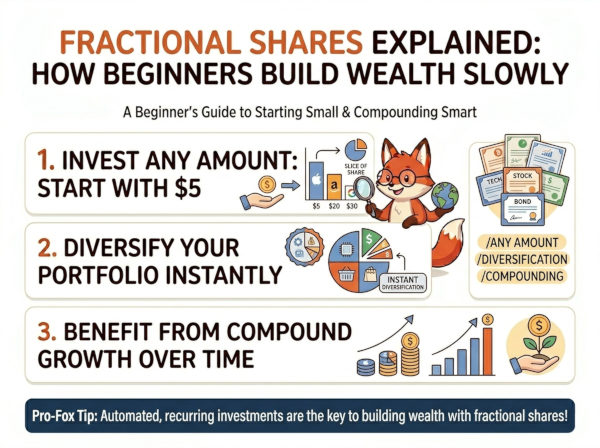
For decades, the stock market was a playground for the wealthy. If you wanted to own a piece of a powerhouse company like Amazon or Google, you had to cough up thousands of dollars for a single share. That barrier to entry kept millions of retail investors on the sidelines. But today, the game has changed entirely.
Welcome to the era of Fractional Shares. This is one of the foundational "Smart Money" lifehacks for anyone looking to build long-term wealth without needing a massive starting capital. By breaking down high-priced assets into bite-sized pieces, you can now own the world’s best companies for the price of a cup of coffee.
How the "Micro-Investment" Mechanism Works
In the past, stock exchanges required whole shares to be traded. Modern brokerage platforms (like Robinhood, Fidelity, or Charles Schwab) have solved this by using "omnibus accounts." When you buy 0.1 shares of a stock, the brokerage buys one whole share for themselves and assigns a portion of it to your ledger. You get the growth, they keep the overhead.
The Step-by-Step Blueprint to Start Investing
To successfully build wealth through fractional investing, follow this systematic approach:
- Step 1: Choose a Fractional-Friendly Brokerage. Ensure your platform supports "dollar-based investing" rather than "share-based investing."
- Step 2: Automate Your Contributions. The real power of fractional shares is "Dollar-Cost Averaging" (DCA). Set a recurring deposit of, say, $20 every Friday. This smooths out market volatility.
- Step 3: Diversify Instantly. With $100, you can own tiny pieces of 10 different blue-chip companies rather than putting all your eggs in one potentially risky basket.
- Step 4: Reinvest Your Dividends. Even if you only earn $0.05 in dividends, use the "DRIP" (Dividend Reinvestment Plan) feature to automatically buy more fractional shares.
Comparison: Traditional Investing vs. Fractional Investing
The flexibility of fractional investing removes the mental barrier of needing "large chunks" of cash to participate in the market.
| Feature | Traditional Investing | Fractional Investing |
|---|---|---|
| Minimum Entry | Price of 1 full share | As low as $1.00 |
| Diversification | Requires thousands | Achievable with $50 |
| Automation | Difficult (needs whole shares) | Seamless (dollar-based) |
| Compounding Effect | Delayed by saving phases | Instant (every dollar works) |
Avoiding the "Penny Stock" Trap
Because fractional shares make it so easy to buy, beginners often feel tempted to buy cheap, volatile "penny stocks." Avoid this. Stick to high-quality companies with strong balance sheets. You are building a foundation for wealth, not playing a casino game. If the company is solid, the fraction you own will grow just as efficiently as a full share would.