How to Sound More Confident in Meetings Without Faking It
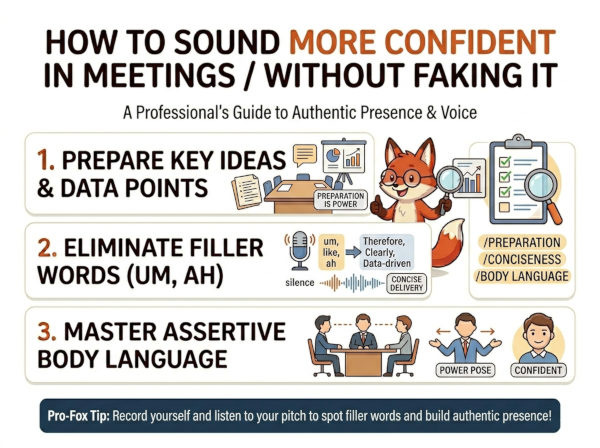
We have all been there. You have a brilliant idea, but the moment you open your mouth in a meeting, your voice wavers, or you apologize before sharing your opinion. You are not alone; even high-performing leaders struggle with "imposter syndrome" during high-stakes discussions. But here is the truth: confidence isn't about being the loudest person in the room—it’s about clarity and presence.
Welcome to The Authentic Authority Blueprint. This is one of the most effective personal development lifehacks for professionals who want to lead without relying on performative "faking it." Today, we will show you how to shift your mindset and adjust your mechanics to project confidence that feels natural and grounded.
The Psychology of Presence (And How to Cultivate It)
When you feel nervous, your nervous system triggers a "fight or flight" response, which often leads to rapid speech and closed-off body language. To sound confident, you must first hack your own biology. Your goal is to move from a state of "reaction" to a state of "intentionality."
The Step-by-Step Blueprint to Projecting Authority
To sound more confident without feeling like an imposter, follow these specific communication rituals:
- Step 1: Eliminate "Softening" Language. Stop using phrases like "I just think," "I'm sorry, but," or "Does that make sense?" These fillers suggest that your contribution requires permission. Replace them with direct, declarative statements.
- Step 2: Master the Power of the Pause. Nervous people feel the need to fill every silence with "um" or "ah." Confident people are comfortable with silence. After you make a key point, stop and let it sink in. It forces the room to focus on your words.
- Step 3: Slow Your Delivery. When we rush, we sound anxious. Consciously slow your speaking pace by 10%. This conveys that you are in control of your time and your message.
- Step 4: Use "We" and "The Evidence." Instead of saying "I feel like we should do X," say "The data suggests that X is our best path forward." By shifting the focus to objective facts, you remove your ego from the equation and sound more authoritative.
Comparison: Performative vs. Authentic Confidence
Understanding the difference between trying to "act" confident and actually *being* confident is the key to long-term professional growth.
| Trait | Performative (Fake) | Authentic (Genuine) |
|---|---|---|
| Speech Style | Loud, fast, interrupting | Measured, clear, assertive |
| Response to Failure | Defensive, blaming others | Accountable, growth-oriented |
| Listening Habits | Waiting for turn to speak | Actively listening to understand |
| Impact on Team | Creates tension/anxiety | Builds trust/clarity |
What to Do When You Don't Know the Answer?
The biggest myth about confident people is that they know everything. The most confident people in the room are the ones who can admit when they lack information without sounding weak. If you are asked a question you can't answer, use this framework:
- Acknowledge: "That is a great question."
- Be Direct: "I don't have the current data on that at my fingertips."
- Pivot: "Let me verify those details and follow up with the team by end-of-day so we have the full picture."
This approach demonstrates professional integrity, which is far more impressive than faking an answer.