Dopamine Detox Explained: Does It Actually Improve Focus?
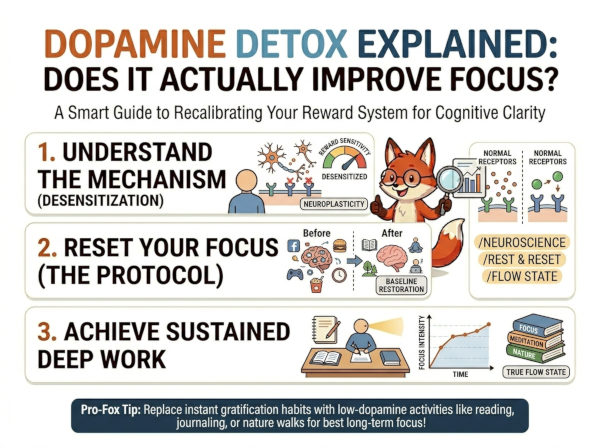
We live in an era of constant stimulation. From the infinite scroll of social media to the ping of a new email, our brains are bombarded with rewards 24/7. This has led to a collective crisis of attention, where the ability to sit still and focus on a single, difficult task feels almost impossible. Enter the "Dopamine Detox"—the latest lifestyle trend claiming to reset your brain.
But does it actually work? Or is it just another passing fad? Today, we are breaking down the science of dopamine, the reality of the detox, and how you can actually reclaim your cognitive clarity.
The Neuroscience: Is Your Brain "Broken"?
It is important to clarify: you cannot actually "detox" dopamine. Dopamine is a vital neurotransmitter essential for motivation, movement, and survival. You wouldn't want to live without it. What you are actually experiencing is **dopamine desensitization**. When you overstimulate your reward system, your brain downregulates its dopamine receptors to protect itself. Essentially, you become "numb" to normal levels of stimulation, which makes daily work feel agonizingly tedious.
The Step-by-Step Blueprint to a Functional Reset
You don't need to live in a dark room for a week to see results. Follow this protocol to recalibrate your reward system effectively:
- Step 1: Identify Your "Super-Stimulants." List the digital habits that consume the most time and provide the highest "hit" of pleasure. For most, this is TikTok, Instagram, or gaming.
- Step 2: Choose Your Detox Window. Start with a "Dopamine Fast" for 24 hours (e.g., Saturday) or a "Digital Sunset" (no screens 2 hours before bed) to establish baseline discipline.
- Step 3: Replace, Don’t Just Remove. If you remove stimulation without replacing it, you will relapse. Fill the void with "low-dopamine" activities: reading, journaling, walking, or focused project work.
- Step 4: Gradually Reintroduce. Do not return to your old habits with the same intensity. Set strict time-gated limits on high-dopamine activities to prevent re-desensitization.
Comparison: Fasting vs. Moderation
How should you manage your brain's reward system for long-term success?
| Approach | Effort Level | Long-Term Sustainability | Focus Impact |
|---|---|---|---|
| Extreme Fasting (No tech) | Very High | Low (Burnout risk) | High (Short-term) |
| Digital Minimalism | Medium | High | High (Consistent) |
| Scheduled "Tech Breaks" | Low | Very High | Medium |
| No Intervention | None | N/A | Low (Degrading) |
When Does the Brain Actually "Reset"?
If you have been hyper-stimulated for years, don't expect a 24-hour fast to fix everything. Research suggests it takes approximately 2 to 4 weeks of consistent low-stimulation behavior to significantly upregulate dopamine receptor sensitivity. The first 3 days will be the hardest—expect boredom, anxiety, and cravings. This is proof that the detox is working: your brain is struggling to find the easy "hits" it used to rely on, and it is finally beginning to heal.