How to Stop Doomscrolling Without Deleting Social Media
You open your phone for “just two minutes.”
Suddenly, an hour disappears.
You jump from bad news to random videos, from outrage posts to endless comment sections, consuming information without even realizing it. Your brain feels overloaded, your energy drops, and somehow you still keep scrolling.
Welcome to the modern doomscrolling trap.
And despite what many productivity gurus claim, the solution is not necessarily deleting every social media app from your life.
The real solution is learning how to use these platforms intentionally instead of allowing algorithms to use you.
Why Social Media Feels Impossible to Stop
Most people blame themselves for lacking discipline.
But modern social media platforms are not neutral tools. They are highly engineered attention-capture systems designed to maximize user engagement for as long as possible.
Every feature is optimized to keep your brain stimulated:
- Infinite scrolling
- Autoplay videos
- Push notifications
- Emotionally triggering content
- Algorithmic personalization
- Variable dopamine rewards
The longer you stay online, the more advertising revenue platforms generate.
The Hidden Psychology Behind Doomscrolling
Social media exploits one of the brain’s strongest psychological vulnerabilities:
Uncertainty.
Your brain constantly believes the “next post” might contain:
- Important news
- Entertainment
- Social validation
- Novel information
- Emotional stimulation
This creates a reward loop very similar to slot machines.
Why Deleting Social Media Usually Fails
Many people attempt extreme digital detoxes:
- Deleting every app
- Blocking all websites
- Turning off phones completely
Sometimes this works temporarily.
But for most users, total removal creates rebound behavior.
Eventually, boredom, loneliness, work requirements, or curiosity pull them back into old habits.
The goal should not be permanent digital isolation.
The goal should be controlled usage.
The “Friction Method” That Actually Works
The most effective anti-doomscrolling strategy is not removing access completely.
It is adding tiny layers of friction between impulse and behavior.
Examples of Productive Friction
| Low-Friction Habit | Higher-Friction Alternative |
|---|---|
| Apps on home screen | Hide apps in folders |
| Instant app opening | Require manual search |
| Saved login sessions | Log out after usage |
| Push notifications enabled | Disable all non-essential alerts |
| Phone beside bed | Charge phone outside bedroom |
Even tiny increases in effort significantly reduce impulsive usage behavior.
The Most Dangerous Doomscrolling Hours
Doomscrolling becomes especially destructive during specific periods:
- Late at night
- Immediately after waking up
- During work avoidance
- After stressful events
- While feeling emotionally drained
These moments weaken self-control and increase emotional vulnerability.
Algorithms detect this engagement behavior quickly and intensify stimulation further.
The “Just One More Scroll” Trap
One reason doomscrolling lasts so long is because feeds never create psychological stopping points.
Books end chapters.
Movies end scenes.
Social feeds never end.
This creates continuous cognitive momentum that keeps users trapped inside passive consumption loops.
2. Opens social media automatically
3. Algorithm delivers emotional stimulation
4. Brain receives dopamine reward
5. User loses time awareness
6. Session extends far beyond intention
Most doomscrolling sessions begin unconsciously.
How Smart Users Rebuild Attention Control
People who successfully reduce doomscrolling usually replace passive consumption with intentional usage systems.
Example Strategy
2. Complete the intended action
3. Exit immediately afterward
4. Avoid algorithmic recommendation feeds
5. Track total screen time weekly
This transforms social media from entertainment default mode into a controlled tool.
The Notification Detox Strategy
Notifications are one of the largest attention destroyers in modern life.
Most alerts are intentionally designed to create urgency.
Even harmless notifications trigger micro-interruptions that weaken concentration.
| Notification Type | Actual Importance | Attention Damage |
|---|---|---|
| Direct Messages | Medium to High | Moderate |
| Breaking News Alerts | Usually Low | High |
| Suggested Content | Very Low | Extreme |
| Like/Follow Notifications | Minimal | High |
| Autoplay Recommendations | None | Extreme |
Disabling non-essential notifications dramatically reduces unconscious app opening behavior.
The Productivity Cost Nobody Notices
Doomscrolling rarely destroys productivity all at once.
Instead, it fragments attention slowly throughout the day.
Constant feed consumption weakens:
- Deep focus
- Memory retention
- Mental clarity
- Task completion speed
- Emotional stability
Many people feel “mentally tired” not because they worked too hard — but because their attention was constantly interrupted.
How to Make Social Media Less Addictive Instantly
Several small adjustments dramatically reduce compulsive scrolling behavior:
- Switch phone display to grayscale mode
- Remove apps from the home screen
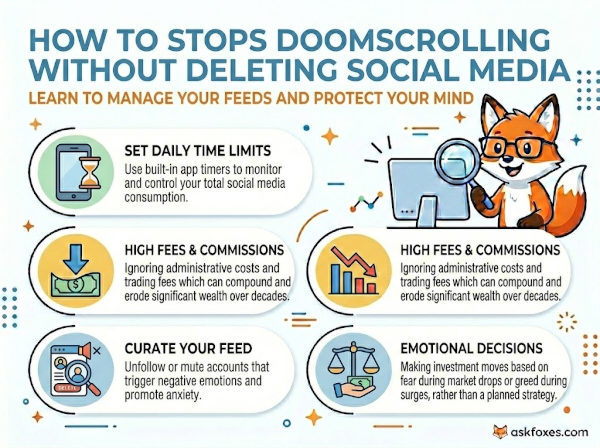
- Use app time limits
- Disable autoplay videos
- Follow fewer outrage-based accounts
- Curate calmer content feeds
Reducing emotional stimulation lowers compulsive engagement naturally.
The Smart User’s Final Rule
Social media itself is not the real problem.
Uncontrolled consumption is.
The goal is not becoming completely disconnected from the digital world.
The goal is reclaiming the ability to decide when technology deserves your attention — instead of reacting automatically every time an algorithm demands it.
Because once your attention becomes permanently fragmented, productivity, focus, and mental clarity quietly disappear with it.