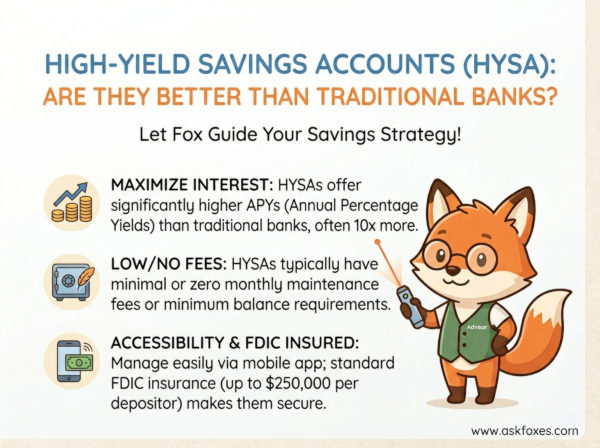
High-Yield Savings Accounts (HYSA): Are They Better Than Traditional Banks?
For decades, the path to saving money was entirely physical. You walked into a brick-and-mortar neighborhood bank branch, filled out a paper deposit slip, and handed your cash to a teller. In return, the bank stored your capital in a standard savings account, offering a tiny trickle of interest as a thank-you. Today, many consumers faithfully maintain this exact routine, assuming all savings accounts are structurally identical. But leaving your cash in a legacy bank means missing out on an arbitrage loop that could be safely expanding your wealth on autopilot.
Welcome to The HYSA vs. Traditional Bank Analysis. In the modern financial layout, where you choose to park your capital dictates how hard your money works for you. Traditional banks rely on physical infrastructure and costly branch networks, passing those expenses down to you in the form of near-zero yields. High-Yield Savings Accounts (HYSAs), primarily engineered by digital-first institutions, completely rewrite these rules. Today, we will break down the structural economics of both banking models so you can make an analytical, high-impact choice for your cash reserves.
The Multiplier Effect: Decoding the Hard Numbers
The primary difference between a traditional account and a high-yield savings tier comes down to the Annual Percentage Yield (APY). While traditional big-box institutions offer standard savings yields that hover at a dismal national average of just 0.38% APY, premium HYSAs frequently offer competitive baseline rates hovering between 3.50% and 4.10% APY.
On paper, a difference of a few percentage points can feel minor. However, when applied to a foundational emergency fund or a dedicated down-payment reserve over a long timeline, the mathematical compounding difference scales dramatically. If you leave $10,000 sitting in a legacy bank account paying 0.38% APY, you will pocket a frustratingly low $38 in interest after a full year. Moving that exact same $10,000 into an optimized digital HYSA yielding 4.00% APY generates $400 in passive returns over the exact same period—entirely risk-free.
The 4-Step Action Plan to Transition to a High-Yield Tier
To successfully migrate your cash safety net away from low-yield traps and lock in maximum interest generation, execute this seamless transition plan:
- Step 1: Isolate the Federal Insurance Wrapper. Never compromise on safety for the sake of a higher yield. Ensure your target digital institution is a verified Member of the Federal Deposit Insurance Corporation (FDIC) or the National Credit Union Administration (NCUA). This legal framework fully guarantees your principal deposit up to $250,000 per depositor, making it just as safe as any historic big-box bank.
- Step 2: Audit the Account Fine Print for Hidden Fees. Top-tier digital providers do not need to attach predatory maintenance fees or strict minimum balance requirements to their products. Prioritize accounts that offer clean, zero-fee structures so your compounding interest earnings are completely insulated from administrative erosion.
- Step 3: Establish a Secure Digital Linking Bridge. Once your new HYSA node is initialized, connect it securely to your primary brick-and-mortar transactional checking account using an electronic ACH layout. This allows you to smoothly slide cash back and forth between your daily checking needs and your high-earning reserve node.
- Step 4: Automate Your Monthly Wealth Influx. Set up an automated recurring transfer rule within your online dashboard to move a fixed percentage of your income to your HYSA every single month. This shifts the operational burden of saving away from your willpower and onto background automation software.
Head-to-Head Comparison: Traditional Banks vs. Premium HYSAs
Evaluating where to anchor your liquid capital requires an objective look at the trade-offs between physical neighborhood convenience and digital wealth optimization.
| Operational Metric | Traditional Big-Box Banks | Online High-Yield Savings (HYSA) |
|---|---|---|
| Average APY Bracket | Ultra-Low (0.01% - 0.38%) | Competitive (3.50% - 4.10%+) |
| Physical Access | High; extensive network of neighborhood branches and ATMs. | None; managed completely via digital web portals and mobile applications. |
| Account Fees | Frequent monthly maintenance charges unless steep balance targets are met. | Typically zero monthly maintenance fees or account balance minimums. |
| Principal Protection | FDIC / NCUA Insured up to $250,000. | FDIC / NCUA Insured up to $250,000. |
The Modern Cash-Flow Hybrid Formula
Are high-yield savings accounts better than traditional banks? For growing your actual capital, the answer is an undeniable yes. However, you do not have to pick one corporate ecosystem and completely abandon the other. The most efficient financial layout uses a hybrid strategy that combines the unique strengths of both banking models:
1. Keep a Local Checking Account for Daily Flow
Maintain your baseline checking account at a local, traditional bank or credit union. Use this hub for immediate ATM cash access, localized branch services, and your daily transactional billing needs.
2. Funnel Your Real Reserves to the Digital HYSA
Keep your actual emergency fund, tax allocations, and long-term vacation or down-payment goals completely separate inside your online HYSA. This shields your primary wealth from everyday spending leaks while forcing the digital core to capture daily compounding interest. Use this straightforward system architecture script to keep your funds balanced automatically:
By restructuring your accounts to capitalize on overhead arbitrage, you stop allowing legacy institutions to profit off your hard-earned deposits. You transition from a passive consumer to an active capital allocator, ensuring that your vital cash safety net stays fully insulated, easily accessible, and perfectly tuned to build your future financial independence.