The Exact Script to Use When Negotiating a Salary Increase in 2026
Entering a salary negotiation is one of the most high-stakes psychological moments in your professional career. Most employees approach this pivotal conversation with an emotional mindset, framing their request around personal financial needs, rising inflation, or milestone anniversaries at the company. But in the modern corporate ecosystem, managers do not hand out salary adjustments based on empathy or tenure. They operate under strict budgetary restrictions and yield to one thing only: objective, non-negotiable data.
Welcome to The Market Value Leverage Protocol. To successfully secure a compensation adjustment, you must stop viewing the interaction as a personal request and start treating it as a strategic business transaction. You are not asking for a favor; you are re-pricing a high-yielding professional asset—your labor—based on real-time market layout dynamics. Today, we will break down the exact behavioral framing and tactical scripts needed to disarm standard corporate pushback and force an immediate upward recalculation of your base salary.
The Anatomy of Corporate Leverage: Math Over Emotion
Corporate human resource departments train managers to deploy standardized defense scripts when an employee requests a raise. They will cite frozen department budgets, strict internal salary bands, or broader macroeconomic uncertainties to defer your adjustment until the next annual review cycle. If you counter these objections with emotional arguments about your living expenses, you validate their framework and lose your leverage.
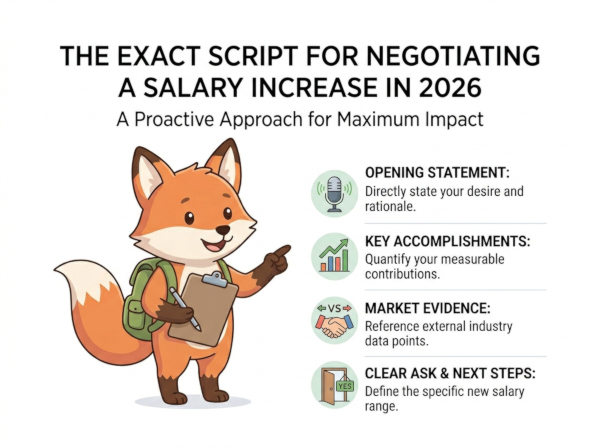
To shatter these automated defense scripts, you must build a bulletproof case around your **Quantifiable Contribution Metrics**. Before you schedule the meeting, document the exact revenue you have generated, the specialized systems you have optimized, or the operational hours you have clawed back for your team over the past 12 months. When you present an undeniable data matrix showing that your structural output far exceeds your current cost, a raise ceases to be an expense for the company—it becomes a mandatory retention strategy to protect their internal workflow.
The 4-Step Action Plan to Prep the Negotiation Board
To ensure your corporate leadership team approaches your compensation review with absolute seriousness, execute this systematic preparation phase:
- Step 1: Extract Your Verified Industry Benchmarks. Do not use vague, unvetted online salary estimates. Gather verified salary ranges from specialized industry reports, localized hiring data, and active job postings from direct competitors to find the exact market rate for your exact role and geographic layout. |* **Step 2: Compile Your Single-Page Impact Ledger.** Build a lean, hyper-focused document detailing your top three professional victories from the past year. Use a strict, numbers-driven formula: "Executed [Action] which directly optimized [Metric] by [Percentage/Dollar Amount], saving the department [Time/Capital]."
- Step 3: Establish Your Target and Walk-Away Boundaries. Never enter a live meeting without a definitive mathematical target. Calculate three distinct numbers: your **Ideal Peak Target** (what you will ask for), your **Acceptable Baseline** (what you will accept), and your **Walk-Away Threshold** (the point where you begin actively interviewing elsewhere).
- Step 4: Secure the Meeting with Neutral Positioning. Do not surprise your manager with a sudden salary demand at the end of a casual catch-up call. Schedule a dedicated calendar block 48 hours in advance using a clear, collaborative description, ensuring they enter the room prepared for a strategic career-path conversation.
The Negotiation Landscape: Emotional Asking vs. Strategic Leverage
Shifting your verbal communication from standard employee compliance to objective asset management completely changes how an executive leadership team calculates your professional value.
| Negotiation Vector | The Standard Consumer Request | The Strategic Sovereign Protocol | |||
|---|---|---|---|---|---|
| Core Justification | Focuses heavily on personal financial strain, cost-of-living spikes, or tenure. | Focuses strictly on measurable revenue impact, operational savings, and market rates. | Handling Corporate Pushback | Accepts the initial "budget freeze" excuse politely and drops the topic for a year. | Pivots smoothly to non-monetary assets or forces a binding performance-review timeline. |
| Documentation Presented | None; relies entirely on verbal arguments and memory during the live conversation. | Presents a clean, single-page impact ledger backed by hard competitor salary indices. | |||
| Power Dynamic | Passive Subordination: Hoping the corporate system rewards your hard work. | Asynchronous Autonomy: Managing your career trajectory like an independent business entity. |
The High-Impact Compensation Re-Pricing Scripts
When executing a live career negotiation, your tone must balance absolute collaborative alignment with firm, unyielding commercial value. Use these two highly specialized verbal scripts to guide the conversation past standard corporate gatekeepers:
1. The Initial Value Presentation Script
Open the negotiation loop by framing your request around your structural contributions and verified open-market metrics. Copy-paste this precise logical structure into your verbal talking points:
2. The Budget-Freeze Counter-Maneuver Script
If your manager deploys the standard defense script ("I want to give you a raise, but our department budget is completely frozen for the quarter"), do not surrender the leverage. Instantly pivot to an asynchronous structural counter-proposal:
By shifting your strategic focus away from a rigid "yes or no" dynamic and toward flexible, systems-driven solutions, you completely out-negotiate traditional corporate HR templates. You stand out as an elite professional who knows their precise worth and respects their own time, locking in the economic trajectory and professional respect required to claim your lifelong personal sovereignty.