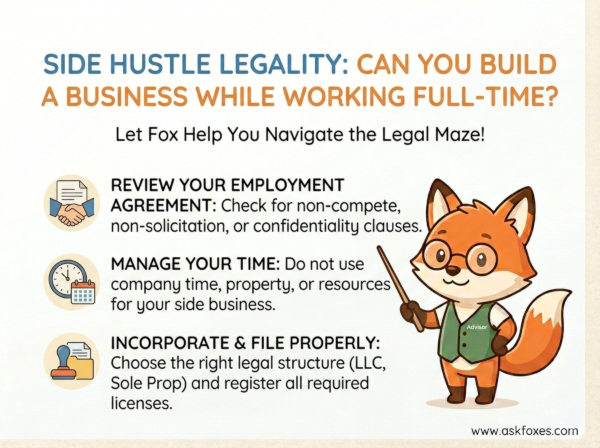
Side Hustle Legality: Can You Build a Business While Working Full-Time?
In the current digital economy, the desire to diversify income through an independent side hustle is a common ambition. However, many professionals move forward without conducting a thorough "risk audit" of their existing employment situation. Building a business while on a full-time payroll is not inherently illegal, but it is a complex navigation of contractual obligations, intellectual property rights, and corporate ethics.
Welcome to The Side Hustle Legality Framework. To build your independent wealth engine without triggering a fireable offense or a legal dispute, you must treat your professional exit and transition strategy like a high-stakes compliance project. Today, we will deconstruct the specific operational barriers and legal landmines that every side-hustling professional must clear before scaling their venture.
The Legal & Contractual Minefield
Before you register a business name or build your first landing page, you must conduct a surgical review of your formal agreements. Most corporate contracts contain specific "restrictive covenants" designed to protect the company's competitive advantage and ensure your total focus.
The 4-Step Legal Compliance Audit
- Step 1: Scrutinize Your Non-Compete and Exclusivity Clauses. Look for "exclusivity" or "full time and attention" clauses. These legally obligate you to dedicate all your professional energy to your current employer, effectively banning outside income streams regardless of whether they compete with your day job.
- Step 2: Define the "IP Ownership" Boundary. Many high-level employment contracts contain "Invention Assignment" clauses. These state that any intellectual property, software code, or creative assets you develop while employed belong to the company, even if they were developed on your own time, using your own equipment.
- Step 3: Analyze Conflict of Interest Parameters. Even without an explicit contract, you are vulnerable if your side hustle targets your employer's client base. Soliciting your employer's customers or employees for your side venture is a guaranteed path to immediate termination and potential civil litigation.
- Step 4: Audit Your "Work-Time" Integrity. The fastest way to justify your own termination is to conduct side-business tasks on company time. Use of company-issued laptops, VPNs, or office software for your private venture is easily trackable by IT departments and constitutes a clear breach of acceptable use policies.
The Risk Assessment Matrix
Not all side hustles carry the same level of legal or professional danger. Use this matrix to evaluate your current business concept against your professional risk tolerance.
| Venture Type | Contractual Risk Level | Recommended Strategy |
|---|---|---|
| Unrelated Service | Low | Keep fully separate; ensure zero overlap with work hours. |
| Industry-Adjacent | Medium | Consult legal counsel regarding non-compete clauses. |
| Direct Competitor | Extreme | Do not proceed without formal, written permission from leadership. |
| Creative/Intellectual | High | Verify IP ownership clauses; ensure zero company tools are involved. |
Operational Protocols for Maximum Protection
To operate your business with the "sovereign operator" mindset, you must build an operational fortress that isolates your side hustle from your full-time role. Follow these systems-driven guidelines:
1. Total Resource Segregation
Create a dedicated "Business Workspace" that exists entirely outside of your employer’s ecosystem. This means a separate laptop, separate cloud storage, a separate business phone number, and a dedicated bank account. If your employer's IT department ever conducts an audit, they should find zero traces of your outside business.
2. The "Silent Scaler" Communication Strategy
Unless your contract explicitly mandates disclosure, treat your side hustle as a private entity. Avoid bragging about your business growth to coworkers or on LinkedIn. Even if your side hustle is perfectly legal, the perception that you are "distracted" can negatively influence your manager's performance reviews or promotion opportunities.
3. Financial & Tax Separation
Formalize your venture by registering as an LLC or a similar legal entity in your jurisdiction. This provides a "corporate veil" that separates your personal liability from your business activity. It also makes tax season significantly easier, as you can clearly document that all business-related income and expenses are handled through a distinct legal channel, separate from your W-2/salary income.
By treating the legal and contractual side of your business with the same rigor you apply to your professional output, you transform your side hustle from a source of stress into a secure, independent asset. Maintain your performance in your full-time role, adhere strictly to your contractual obligations, and build your venture in the "quiet" zones of your life until it is robust enough to provide the sovereignty you seek.
Disclaimer: Employment laws and contract enforceability vary significantly by jurisdiction. If you are concerned about potential risks, consult an employment attorney to review your specific agreement before launching your venture.