Speed Reading for Busy Adults: How to Read 52 Books a Year Easily
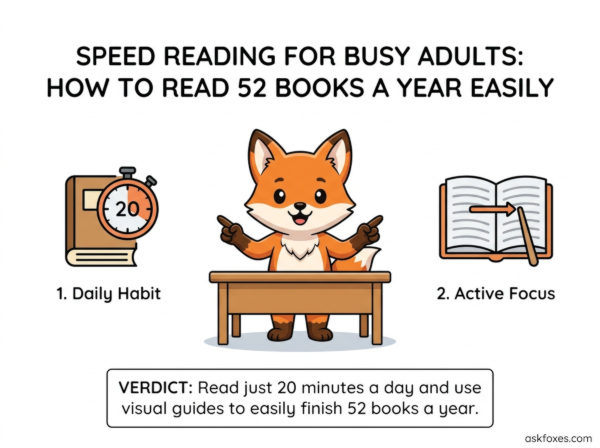
In a world where knowledge is the primary currency, the ability to read and synthesize information quickly is your greatest competitive advantage. Most adults read at the same pace they learned in primary school—sub-vocalizing every word and getting bogged down in filler text. To reach a goal like 52 books a year, you must stop "reading" in the traditional sense and start "data-mining" the text for high-leverage insights.
Welcome to The High-Velocity Reading Protocol. Speed reading is not about skimming; it is about intentional engagement and bypassing the mental bottlenecks that slow down your eye movement. Today, we will deconstruct the systematic approach to processing dense material with speed and high-level retention.
The Mechanics of Accelerated Processing
To read 52 books a year, you must average one book per week. This is entirely achievable if you stop treating every page as equally important and start focusing on the structures that hold the author's argument together.
The 4-Step Blueprint to Rapid Information Absorption
- Step 1: The "Structural Preview." Before diving in, spend 5 minutes reviewing the Table of Contents, the index, and the introduction. Understand the author’s primary thesis and the roadmap of their arguments. This primes your brain to recognize the "critical" content later.
- Step 2: Eliminate Sub-vocalization. Use a pointer (your finger or a pen) to guide your eyes across the page. Your eyes follow movement naturally, and by moving the pointer faster than your comfortable reading speed, you force your brain to stop "hearing" the words and start "seeing" the concepts.
- Step 3: Apply the "80/20 Reading Rule." Most non-fiction books contain 80% fluff and 20% high-impact content. Scan for the core arguments, bolded headers, and concluding summaries. When you find a section that adds no new value to the thesis, skip it entirely.
- Step 4: Active Output (The "Feynman" Summary). Reading is only half the process. Once finished, write a 3-bullet point summary of the book’s core utility. If you cannot explain the book's main idea in three sentences, you have not read it—you have only passed your eyes over the ink.
The Reading Matrix: Passive Consumption vs. Strategic Data-Mining
Analyze the difference between traditional reading and strategic processing to understand where your reading capacity is currently being throttled.
| Operational Metric | Passive Reading (Traditional) | Strategic Data-Mining |
|---|---|---|
| Internal Voice | Sub-vocalizing every word (Slow). | Silent; visual scanning only (Fast). |
| Engagement | Reading cover-to-cover, regardless of fluff. | Focusing on high-leverage chapters and theses. |
| Retention | High immediate; low long-term recall. | Low immediate; high synthesis through output/summary. |
| Annual Capacity | Low: 5-10 books per year. | High: 52+ books per year. |
The "Information Processing" Operational Code
When you start your weekly book, do not approach it as a narrative experience. Approach it as an intelligence-gathering mission. Use this internal logic to maintain your speed without losing comprehension:
By shifting your approach from "reading" to "mining for insights," you dramatically increase your volume of consumed knowledge. You are not just reading more books; you are absorbing more strategic leverage. Master these processing techniques, and you will find that 52 books a year is not only manageable—it is the baseline for your ongoing intellectual growth.