How to Build a Second Brain Using Free Note-Taking Apps
In an age of constant information overload, your brain is over-capacity. You are using your mental bandwidth to *store* information, which is a massive inefficiency that prevents you from *creating* information. To achieve peak mental clarity, you must stop treating your brain as a warehouse and start using it as a processing unit. By building a "Second Brain," you create an external system that captures, organizes, and retrieves your knowledge automatically.
Welcome to The Second Brain Architecture. You do not need expensive project management software or complex enterprise tools to build an elite knowledge system. All you need is a disciplined workflow and a basic, free note-taking application. Today, we will deconstruct the "CODE" framework—the operational system used by top thinkers to scale their intellectual output—using zero-cost digital tools.
The CODE Framework: Your Operational Workflow
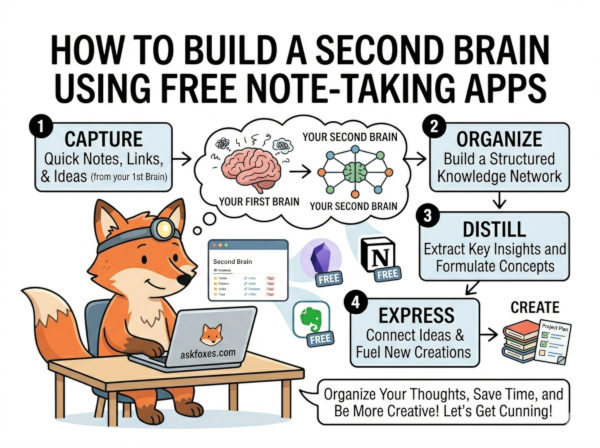
To build a Second Brain that actually produces results, you must move beyond simply "taking notes." You must follow the four-stage CODE framework to process information from raw data into finished work.
The 4-Step Knowledge Engineering Blueprint
- Step 1: Capture. Do not trust your memory. Use a free app (like Notion, Obsidian, or Google Keep) to immediately record your ideas, articles, or meeting insights. If it’s not captured in your system, it effectively does not exist.
- Step 2: Organize. Use the "PARA" method to categorize your notes: Projects (things you are working on), Areas (things you are responsible for over the long term), Resources (topics you are interested in), and Archives (completed or inactive items).
- Step 3: Distill. Do not keep raw, long-form content. Summarize your notes into "atomic insights." Boil down a 20-page document into the three most critical takeaways that you can understand at a glance.
- Step 4: Express. The purpose of your Second Brain is to produce. Use your organized and distilled insights to build your projects—whether that is a client report, a presentation, or a creative asset—without starting from a blank page.
The Knowledge Matrix: Passive Filing vs. Second Brain
Compare the impact of traditional note-taking against the Second Brain approach to see how your intellectual output is currently being throttled.
| Operational Metric | Passive Note-Taking | The Second Brain Protocol |
|---|---|---|
| Information Flow | Scattered; notes are lost in different apps/paper. | Centralized; all information is indexed in one location. |
| Utility of Notes | Dead; notes are rarely reviewed after creation. | Alive; information is synthesized into active projects. |
| Creation Speed | Slow; you start every task from scratch. | Fast; you leverage previous work to assemble new projects. |
| Cognitive Load | Overloaded: Your brain is trying to remember everything. | Optimized: Your brain is free to focus on deep thinking. |
The "Second Brain" Operational Code
When you start building your system, do not get caught up in the "perfect setup." The best Second Brain is the one you actually use. Use this internal logic to maintain the system's operational integrity:
By building a Second Brain, you gain a massive competitive advantage: the ability to build upon your past self. You no longer suffer from "the blank page syndrome" because your digital archive is already filled with your own curated, refined thoughts. Master these free tools, implement the CODE workflow, and transform your knowledge from a disorganized mess into a scalable, personal intellectual asset.