Hidden City Ticketing: The Controversial Way to Save Hundreds on Airfare
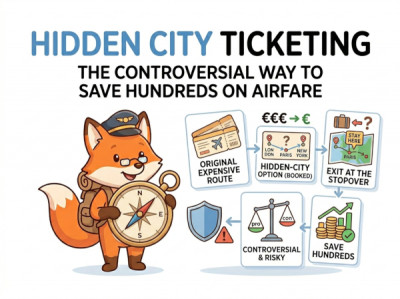
In the rigid architecture of airline pricing, a direct flight from Point A to Point B is often priced higher than a flight from Point A to Point C with a layover in Point B. This happens because airlines compete on routes where they have rivals, and they price direct flights based on the "value" of the destination. Hidden city ticketing is the act of booking the Point A to Point C route, but intentionally ending your journey at the layover city (Point B). It is a controversial, high-leverage hack that can slash your airfare costs by hundreds, but it requires cold, clinical execution.
Welcome to The Hidden City Protocol. Airlines actively discourage this practice because it disrupts their revenue management models, but it is not illegal. However, it is an "operational maneuver" that carries specific risks. Today, we will deconstruct the rules of engagement for hidden city ticketing to ensure you capture the savings without triggering carrier sanctions.
The Rules of Engagement: Strategic Execution
You cannot use this hack like a standard traveler. One mistake—like checking a bag or using your frequent flyer number—will destroy the efficiency of this strategy.
The 4-Step Blueprint to Hidden City Execution
- Step 1: Never Check a Bag. This is the absolute golden rule. If you check a bag, it will be automatically routed to your final destination (Point C), not the city where you intend to exit (Point B). You must travel with carry-on luggage only.
- Step 2: Book One-Way Tickets Only. If you book a round-trip ticket and skip a segment, the airline will automatically cancel every subsequent leg of your journey. Use hidden city ticketing for one-way segments only to keep your itinerary "clean."
- Step 3: Do Not Include Frequent Flyer Details. Airlines track "hidden city" abusers. Do not input your frequent flyer number into the booking; it links the activity directly to your profile, increasing the risk that the airline will flag your account or revoke your loyalty status.
- Step 4: Use Specialized Monitoring Tools. Finding these fares manually is nearly impossible. Use search engines like Skiplagged, which are specifically engineered to identify these "hidden city" anomalies and present them as valid booking options.
The Risk Matrix: Standard Booking vs. Hidden City
Assess the trade-offs between standard booking reliability and the high-value potential of hidden city ticketing.
| Operational Metric | Standard Booking | Hidden City Ticketing |
|---|---|---|
| Flexibility | High; changes/returns are standard. | Near-zero; strictly one-way, no changes. |
| Baggage Handling | Standard; checked bags reach the destination. | Prohibited; carry-on only (mandatory). |
| Airline Relations | Neutral. | Adversarial; potential for account flagging. |
| Cost Efficiency | Baseline: Market-standard pricing. | Optimized: Massive savings on otherwise expensive routes. |
The "Hidden City" Operational Code
To operate successfully within this high-risk, high-reward space, you must treat your booking as a covert operational move. Maintain strict discipline to prevent the airline's systems from detecting your intent.
Hidden city ticketing is the ultimate "power user" hack for the global traveler. It ignores the marketing logic of the airlines and exploits the raw data of their pricing engine. Master the risks, adhere strictly to the no-checked-baggage rule, and you will effectively arbitrage the airline industry's own pricing algorithms to fund your travel habit at a fraction of the cost.