Packing Light: How to Fit 2 Weeks of Clothes Into a Free Personal Item Bag
Checking a bag is a massive operational inefficiency. It introduces the risk of loss, forces you to wait at baggage claim, and often incurs unnecessary fees. To travel with true sovereignty, you must master the "personal item" limit. Fitting two weeks of clothing into a single, compact bag is not about magic—it is about rigorous material selection and folding discipline.
Welcome to The Personal Item Protocol. By reducing your inventory to the absolute essentials, you gain mobility and speed, allowing you to bypass every airport bottleneck. Today, we will deconstruct the strategy required to pack for an extended duration while adhering to the strictest size constraints.
The Minimalist Packing Blueprint
To pack for 14 days in a small bag, you must move from a "multiple outfits" mindset to a "modular layering" mindset.
The 4-Step Personal Item Execution Protocol
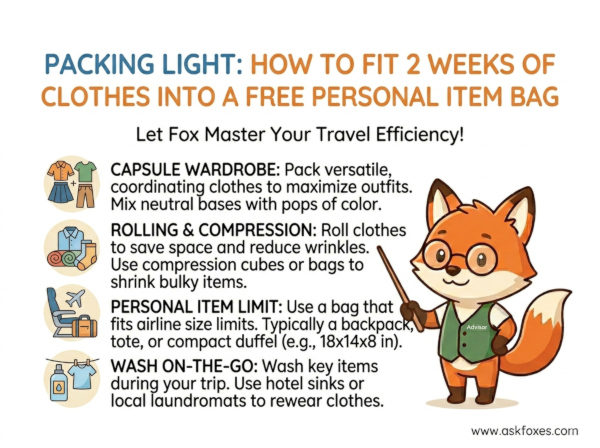
- Step 1: Fabric Selection Optimization. Eliminate cotton. Cotton is bulky, heavy, and slow to dry. Switch to synthetic or merino-wool blends. These materials are lightweight, moisture-wicking, highly compressible, and—most importantly—odor-resistant, meaning you can wear items multiple times before needing a wash.
- Step 2: The "Rule of Three" Modular System. Pack three sets of base layers (socks, underwear, undershirts), two bottoms, two shirts, and one mid-layer. This is your foundation. Since you are wearing your heaviest items (jacket, boots) on the plane, this modular setup is sufficient for an indefinite duration, provided you have access to laundry every 5-7 days.
- Step 3: Compression Folding & Nesting. Do not fold your clothes into flat stacks. Use "Ranger Rolls" (tight, cylindrical bundles) to save space and minimize wrinkles. Place the heaviest, largest items at the bottom of the bag and nest your smaller bundles in the gaps.
- Step 4: Consolidate Your Infrastructure. Use a small, dedicated pouch for your "EDC" (Every Day Carry) items—chargers, toiletries, and documents. If your tech gear and toiletries take up too much room, you are carrying too much. Digitize your documents and choose multi-purpose toiletries to shrink your footprint.
The Packing Matrix: Traditional vs. Modular Protocol
Compare the traditional approach to packing with the high-output, minimalist protocol to see where your efficiency is currently leaking.
| Metric | Traditional Packing (The "Just-in-Case" Method) | Modular Packing (The "Personal Item" Method) |
|---|---|---|
| Clothing Quantity | 14+ individual daily outfits. | 3-day modular rotation (washed as needed). |
| Luggage Footprint | Checked bag; high fees; risk of loss. | Personal-item bag; zero fees; zero risk. |
| Transit Mobility | Low; hampered by heavy/bulky bags. | High; total mobility; no baggage claim delay. |
| Cognitive Load | High: Stress of bag management. | Optimized: Total focus on destination/mission. |
The "Minimalist" Operational Code
To succeed at packing light, you must view every item in your bag as a liability. If it does not serve a daily purpose, remove it.
By mastering the personal-item limit, you liberate yourself from the standard baggage infrastructure. You move faster, pay less, and operate with more freedom. Master these compression techniques, maintain your modular rotation, and you will find that you can sustain two weeks (or two months) of travel without ever needing a checked bag again.