How to Travel Europe on $40 a Day: Realistic Budgeting & Hacks
Traveling Europe on $40 a day is often dismissed as a relic of the past, but it remains entirely achievable if you treat your journey as an optimization problem rather than a standard vacation. The difference between a $40 day and a $150 day is not a lack of enjoyment; it is a difference in logistics, planning, and your ability to bypass high-cost "tourist-trap" infrastructure.
Welcome to The European Budgetary Protocol. To sustain this price point, you must move away from capital cities and Western European tourist hubs, opting instead for high-utility, low-cost regions. Today, we will deconstruct the operational framework required to explore Europe while maintaining strict financial discipline.
The European Efficiency Blueprint
To succeed at a $40-per-day threshold, you must strictly manage your core expenditure categories: geography, shelter, and caloric intake.
The 4-Pillar Budgetary Framework
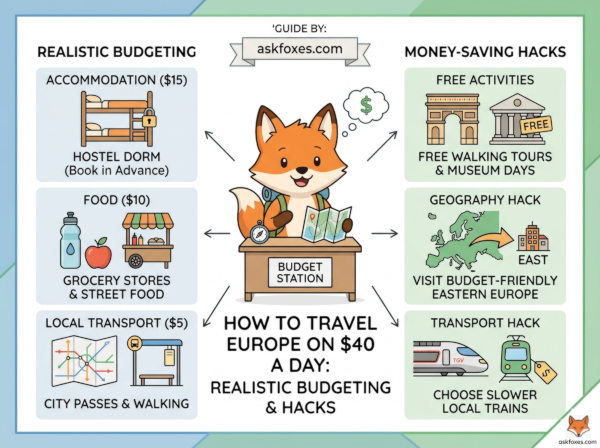
- Pillar 1: Geographic Arbitrage. Focus your itinerary on Central and Eastern Europe. Destinations such as Krakow (Poland), Budapest (Hungary), Belgrade (Serbia), and Sofia (Bulgaria) provide historical density and architectural beauty at a fraction of the cost of Western European capitals. Your dollar holds significantly more purchasing power in these nodes.
- Pillar 2: High-Efficiency Accommodation. Utilize hostels that offer kitchen facilities, which are essential for self-catering. If you are staying for longer periods, investigate "work-exchange" programs like Worldpackers or WorkAway, which trade labor for free room and board. Always look for lodging slightly outside the city center, near high-frequency public transit nodes.
- Pillar 3: Tactical Sustenance. Restaurant dining is the fastest way to break your $40 budget. Prioritize self-catering by utilizing budget supermarkets like Lidl or Aldi. If you must eat out, target the "Lunch Special" (e.g., Menu del Dia), which offers multi-course value for a fraction of the dinner price. Always avoid restaurants with English-language signage, as these are premium-priced.
- Pillar 4: Optimized Transit. Avoid taxis entirely. Use budget-friendly bus lines like FlixBus for intercity transit, which are consistently cheaper than rail for short-to-medium hauls. For local travel, purchase 24-hour or weekly transit passes, which offer a lower per-trip cost compared to single-ticket purchases.
The Budget Matrix: Standard Travel vs. Optimized Operations
Assess how your daily spending behavior dictates your total travel capacity.
| Operational Metric | Standard Tourist Profile | Budget-Optimized Operator |
|---|---|---|
| Accommodation | Hotels/Central Airbnbs; high cost. | Hostels/Work-exchanges; low/zero cost. |
| Sustenance | Restaurant dining (3x daily). | Self-catered/Local lunch specials. |
| Transportation | Taxis/High-speed Rail. | Public transit/Budget bus lines. |
| Operational Load | Low: High convenience, high cost. | High: High discipline, low cost. |
The "European Budget" Operational Code
To maintain your $40-per-day target, you must adhere to your financial constraints with the same discipline you apply to a business project. Use this logic to regulate your spending:
By implementing these hacks, you stop being a tourist who is "paying for convenience" and start being an operator who is "paying for experience." You will find that these small, disciplined decisions accumulate, allowing you to stay on the road longer and see more of Europe than your peers who rely on standard, high-cost booking patterns. Master the discipline, and $40 will be more than enough to sustain a high-value, transformative travel lifestyle.