The Best Free Textbooks Websites: Stop Paying Hundreds for College Books
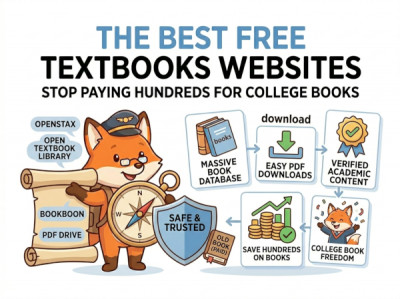
The traditional collegiate textbook model is a legacy system designed to extract maximum capital from students who are already financially burdened. In the digital age, paying $200 for a printed textbook that will be obsolete in a semester is an operational failure. To optimize your academic budget, you must shift toward open-access and peer-reviewed digital alternatives that provide identical—or superior—information for zero cost.
Welcome to The Textbook Arbitrage Protocol. By centralizing your study resources through reputable, open-access repositories, you can bypass the "textbook tax" entirely. Today, we will deconstruct the essential digital hubs where you can procure high-quality academic materials without spending a cent.
The High-Efficiency Resource Stack
To optimize your research and study time, you must prioritize platforms that offer verified, peer-reviewed, and professionally curated academic content.
The 4-Pillar Open-Access Framework
- Pillar 1: OpenStax (Rice University). This is the industry standard for OER. It offers high-quality, peer-reviewed, and professionally designed textbooks covering core subjects like Biology, Physics, and Economics, all available for free digital download.
- Pillar 2: Directory of Open Access Books (DOAB). This is a massive, community-driven database that links to thousands of scholarly, peer-reviewed books across all academic disciplines. It is highly effective for research-heavy courses where you need diverse perspectives.
- Pillar 3: Project Gutenberg. While focused on classic literature and historical texts, this is an essential resource for students in Humanities, Philosophy, and English Literature. It hosts over 70,000 free, public-domain ebooks that are staples of many syllabi.
- Pillar 4: MIT OpenCourseWare. Beyond just textbooks, this platform provides access to course notes, lecture slides, and supplementary materials directly from MIT courses. It is the ultimate tool for deep-dive technical subjects where traditional textbooks often fall short.
The Textbook Matrix: Commercial Publishing vs. Open-Access Strategy
Understand the shift from traditional consumption to optimized academic resource management.
| Metric | Commercial Textbooks (Legacy) | Open-Access Strategy (Optimized) |
|---|---|---|
| Financial Cost | $100 - $300 per unit. | $0. |
| Availability | Dependent on bookstore stock/delivery. | Instant; accessible anywhere/anytime. |
| Update Frequency | Slow; rigid publishing cycles. | Fast; iterative and digital-first. |
| Operational Load | Negative: Financial debt service. | Optimized: High-utility, zero cost. |
The "Textbook Arbitrage" Operational Code
To maintain your academic efficiency without draining your capital, treat your resource acquisition as a structured project. Use this logic to execute your textbook search:
By moving from a "buy-what-you-are-told" mindset to an "arbitrage-driven" strategy, you preserve your financial assets while accessing superior academic resources. You aren't just saving money; you are building a digital, portable, and permanent library that will serve you throughout your academic career. Master these sources, maintain your digital archive, and you will effectively terminate the textbook tax for the duration of your studies.