Transitioning to Adulthood: Essential Financial Lessons They Don't Teach in School
The transition to adulthood is an operational crisis. You are moving from a state of controlled dependency to one of total personal accountability, yet the traditional education system provides zero training on the mechanics of financial sovereignty. To thrive, you must stop viewing money as a medium for consumption and start viewing it as a tool for leverage.
Welcome to The Financial Sovereignty Protocol. By mastering the fundamental mechanics of capital, credit, and risk, you can bypass the cycle of paycheck-to-paycheck instability that traps most young adults. Today, we will deconstruct the essential financial lessons required to build an unshakeable foundation.
The Financial Foundation Blueprint
To achieve independence, you must prioritize the acquisition of high-value financial habits and systems early in your career.
The 4-Pillar Sovereignty Framework
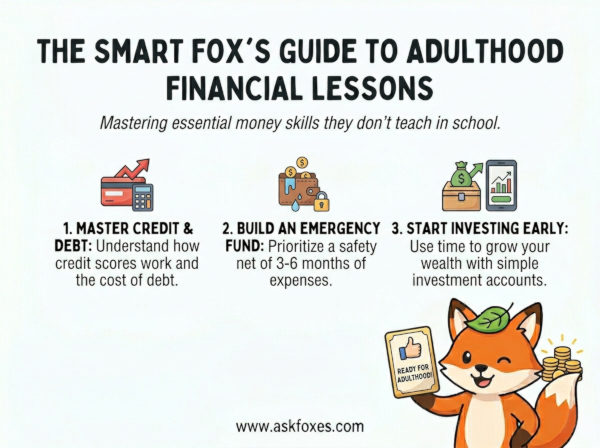
- Pillar 1: The Credit Architecture. Your credit score is a logistical asset, not a badge of honor. Master it by treating every credit card as a debit card: never spend money you do not currently possess. Pay your full balance every month to maintain a perfect payment history, which acts as a multiplier for your future purchasing power.
- Pillar 2: The Emergency Operational Reserve. Before investing or luxury spending, build an "operational reserve" covering 3–6 months of essential survival expenses (rent, food, utilities). This is not an investment; it is a defensive tool that prevents you from entering high-interest debt when life inevitably produces a shock.
- Pillar 3: The Automation Protocol. Human willpower is a finite resource. Remove the burden of decision-making by automating your savings and investments. Set up direct deposits that route a fixed percentage of your income directly into a high-yield savings or investment account before you ever see it in your checking account.
- Pillar 4: Risk Mitigation via Insurance. Adulthood involves managing asymmetric risk. Understand the necessity of basic protections—renters insurance, health insurance, and disability coverage—which cost pennies per day but prevent catastrophic financial failure if an accident occurs.
The Financial Matrix: Consumer vs. Sovereign Operator
Assess your financial positioning based on your management of debt, savings, and long-term risk.
| Metric | Consumer Profile | Sovereign Operator Profile |
|---|---|---|
| Debt Strategy | Accumulates debt for consumption. | Eliminates debt; leverages for growth. |
| Income Flow | Immediate consumption/lifestyle creep. | Prioritized for savings/asset acquisition. |
| Risk Profile | Reactive; lacks emergency buffer. | Proactive; insured and fully reserved. |
| Operational Status | Negative: Constant financial stress. | Optimized: High-utility, compounding growth. |
The "Financial Sovereignty" Operational Code
To successfully navigate your transition to adulthood, treat your personal finance as a high-stakes enterprise. Use this logic to ensure your fiscal health remains robust:
By enforcing these standards, you stop being a victim of your financial circumstances and start being the architect of your net worth. The process requires discipline, but the result is a level of freedom that the average consumer will never know. Master the mechanics of sovereignty, maintain your operational discipline, and you will secure a foundation that supports your ambitions for decades to come.