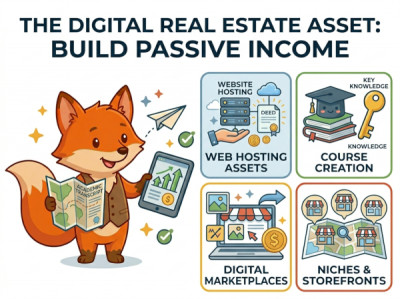
The Digital Real Estate Asset: Build Passive Income
The traditional dream of financial freedom usually involves physical real estate. We are told to save up $50,000 for a down payment, take on a massive 30-year mortgage, and rent out a brick-and-mortar property to tenants. While that strategy worked perfectly for previous generations, today’s market presents a massive barrier to entry for young creators: soaring interest rates and inflated property prices.
But the rules of property ownership have fundamentally shifted online. You don't need a massive bank loan to become a landlord anymore. Welcome to the era of Digital Real Estate. This is the art of building low-maintenance, high-yield digital assets that generate automated cash flow month after month while you sleep.
The Anatomy of a Low-Friction Cash Flow Asset
Unlike a physical apartment that requires plumbing maintenance and structural repairs, a digital asset scales with near-zero marginal cost. Once the foundational framework is engineered, the cost of serving 10,000 users is virtually identical to serving 10 users.
Three Highly Profitable Digital Property Models
To begin building your virtual portfolio, you must focus on assets that can be easily systematized and automated:
- 1. Automated Niche Content Sites: Building micro-utility or deeply specific information portals. Once rank position is locked in search engines, programmatic ad platforms (like Google AdSense) pay you monthly rental checks purely based on automated traffic.
- 2. Curated Premium Newsletters: Building an audience around a specific industry index or tool aggregation. Sponsors pay premium placement fees to get inside your readers' inboxes every week.
- 3. White-Label SaaS Extensions: Deploying basic browser extensions or API utilities that solve a single, irritating problem for e-commerce stores or creators on a recurring subscription basis.
Investment Analysis: Physical vs. Digital Assets
Let's break down the mathematical reality of starting a digital property venture compared to traditional asset classes:
| Asset Metric | Physical Rental Property | Digital Real Estate Asset |
|---|---|---|
| Startup Capital Required | High ($20,000 - $100,000+) | Very Low ($10 - $100 for domain/hosting) |
| Profit Margins | Low (Typically 10% to 20% after expenses) | Extreme (85% to 95% pure profit) |
| Scalability Speed | Slow (Requires years to buy a second home) | Instant (Can replicate sites globally in minutes) |
The Step-by-Step Blueprint to Secure Your First Plot
Ready to deploy your first revenue-generating virtual asset? Follow this technical sequence to ensure your property is structured for long-term equity growth:
Step 1: Identify an Under-Served Micro-Niše
Do not try to build another generic tech or fashion site. Narrow your focus down to a razor-sharp, actionable point. Instead of "Fitness," build a site dedicated exclusively to "Calisthenics Workouts for Remote Software Engineers." Low competition means fast visibility.
Step 2: Automate the Content Lifecycle
Set up automated templates and content pipelines. Schedule your structural updates, programmatic data feeds, or articles months in advance. Your goal is to move the asset from active maintenance to passive monitoring within the first 90 days.