Arbitrage Secrets: How to Find Cheap Items Locally and Flip Them Online
Arbitrage is not gambling; it is a calculated engineering process. You are identifying a delta—a price difference—between a localized, inefficient market and a global, liquid marketplace. To succeed, you must move beyond "hunting for deals" and start operating a logistics-focused asset acquisition business. In 2026, the competitive edge belongs to those who use data to identify these inefficiencies at scale.
Welcome to The Arbitrage Protocol. Today, we will deconstruct the systematic framework required to source, validate, and rotate inventory for maximum profit.
The Arbitrage Asset Blueprint
To succeed, focus on high-velocity inventory categories where demand is consistent and market pricing is easily verifiable.
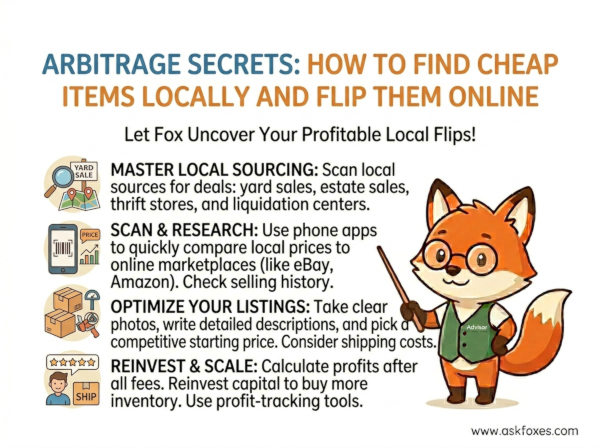
The 4-Pillar Arbitrage Framework
- Pillar 1: Data-Driven Sourcing. Utilize store-specific scanner apps (like the Amazon Seller App) to verify current market pricing, sales rank, and profit margins in real-time. Focus your search on high-turnover niches like toys, beauty products, and home goods.
- Pillar 2: Tactical Local Acquisition. Target "clearance cycles" at big-box retailers, discount outlets (like TJ Maxx or Ross), and pharmacy chains where coupon stacking can drastically lower your cost of goods. Use tools like BrickSeek to verify local inventory before traveling to avoid wasted effort.
- Pillar 3: The Online Scaling Protocol. Transition from physical retail to online arbitrage by utilizing data tools like Keepa to track historical price spikes and SellerAmp for advanced profit filtering. Leverage "Amazon-to-Amazon" flips to capitalize on temporary supply chain gaps.
- Pillar 4: Value-Addition Engineering. Increase your resale margins by cleaning, repairing, or simply providing high-quality, professional photography for your items. Perceived value is a massive lever in digital marketplaces; professional presentation allows you to command higher prices.
The Arbitrage Matrix: Speculative vs. Data-Driven Model
Compare the operational impact of random hunting versus a systematic, data-led arbitrage workflow.
| Metric | Speculative/Random Hunter | Systematic Arbitrage Operator |
|---|---|---|
| Sourcing | Random; relies on luck. | Systematic; relies on scanner data. |
| Pricing | Guesswork. | Verified against market trends. |
| Efficiency | Low; high effort/time. | High; data-driven prioritization. |
| Operational Status | Negative: Unpredictable returns. | Optimized: Scalable, repeatable profit. |
The "Arbitrage" Operational Code
To scale your flipping business, treat your process as an automated logistical system. Use this logic to ensure your rotations remain profitable:
By enforcing these standards, you transform your flipping operation from a random venture into a repeatable engine for capital growth. Master the logistical pipeline, maintain your discipline with data-driven decision-making, and you will consistently extract value from market inefficiencies.