The Ultimate Guide to Micro-Flipping: Buying and Selling Cheap Digital Assets
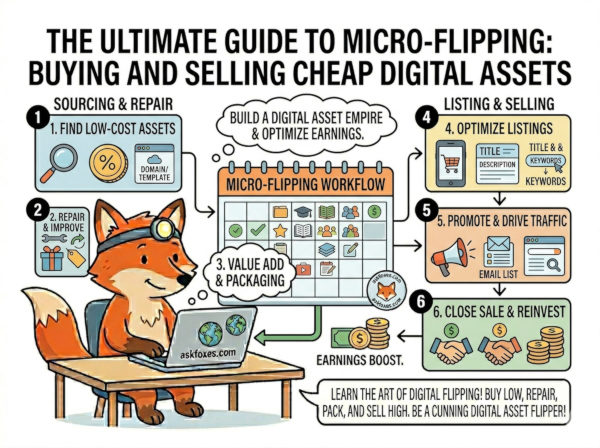
Micro-flipping is the digital equivalent of "day trading" for assets. Unlike long-term digital business building, micro-flipping relies on identifying under-monetized assets—such as dormant domain names, small starter websites, or unoptimized social media accounts—improving them marginally, and reselling them to a buyer who values the "ready-to-go" state. It is a high-velocity strategy that prioritizes speed, cash flow, and market arbitrage.
Welcome to The Micro-Flip Protocol. Today, we will deconstruct the systematic framework required to source, optimize, and rotate digital assets for rapid profit.
The Micro-Flipping Asset Blueprint
To succeed at micro-flipping, you must treat your inventory as short-term capital. Your goal is to increase the asset's "perceived value" with minimal hours of work.
The 4-Pillar Flipping Framework
- Pillar 1: Undervalued Sourcing. Use marketplaces like Flippa, Acquire.com (for micro-projects), or specialized domain auction houses. Look for assets with "basic functionality" that are failing because of poor aesthetics, non-existent SEO, or lack of monetization, which you can fix cheaply.
- Pillar 2: High-Impact Optimization. Focus on "low-hanging fruit." Update the site's copy, replace low-quality imagery with high-end AI-generated graphics, implement basic SEO keywords, or set up a simple automated email capture sequence. These small changes drastically improve the asset's attractiveness to end-buyers.
- Pillar 3: Monetization Validation. Buyers pay for cash flow. If you can prove that an asset earns even $20–$50 per month through ads or affiliate links, its resale value jumps significantly. Proving even minimal revenue is the most powerful tool in your flipping kit.
- Pillar 4: Systematic Exit Strategy. Do not get attached to the asset. List the optimized site back on the same marketplace where you bought it, showcasing your improvements as the "new" potential for growth. Market the asset’s "turnkey" status to attract buyers who want the work done for them.
The Flipping Matrix: Passive Investing vs. Active Micro-Flipping
Compare the operational impact of holding long-term digital assets versus high-velocity micro-flipping.
| Metric | Long-Term Digital Investing | Active Micro-Flipping |
|---|---|---|
| Time Horizon | Years; slow compounding. | Weeks; rapid turnover. |
| Focus | Scaling and operations. | Optimization and resale. |
| Risk Profile | Lower; mature assets. | Higher; depends on market liquidity. |
| Operational Load | Low: Management-focused. | High: Search and repair-focused. |
The "Micro-Flip" Operational Code
To scale your micro-flipping business, treat your process as an automated workflow. Use this logic to ensure your flips remain profitable:
By enforcing these standards, you transform your flipping strategy from an erratic hobby into a calculated engine for capital growth. You are not building businesses; you are building and selling "ready-to-operate" digital systems. Master the market, maintain your discipline regarding time-per-flip, and you will consistently generate high-velocity returns.