Hidden Bank Account Fees Nobody Notices Until It’s Too Late
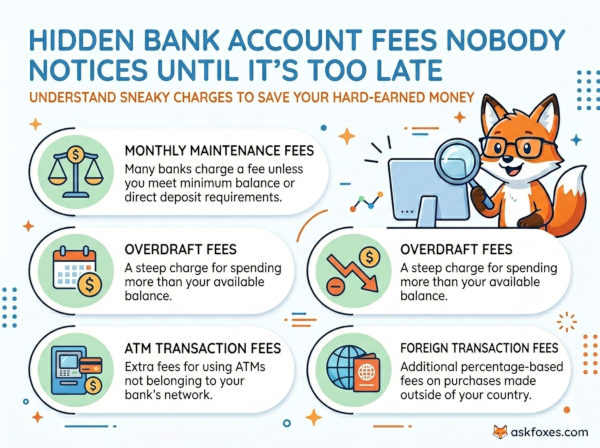
Most people believe banks are safe places to store money. What they do not realize is that modern banks have quietly transformed into fee-generating machines designed to extract small amounts of money from customers over time.
And the most dangerous part? Many of these charges are intentionally designed to go unnoticed.
A few dollars here. A small “service fee” there. Tiny deductions hidden inside complicated monthly statements. Individually, they seem harmless. But over the course of a year, these invisible charges can quietly drain hundreds — sometimes thousands — from your account.
Why Banks Depend on “Invisible Charges”
Large banks generate billions of dollars annually from customer fees alone. In many cases, fee revenue is more profitable than traditional lending activities.
Banks understand a simple psychological truth:
People rarely scrutinize small recurring deductions.
That is why many banking fees are intentionally structured to feel insignificant enough to ignore.
- $4.95 monthly maintenance fees
- $2.50 ATM withdrawal charges
- $15 overdraft “protection” fees
- $10 paper statement charges
- $35 wire transfer penalties
Over time, these charges quietly compound into serious financial leakage.
The Most Common Hidden Bank Fees
Some banking charges are obvious. Others are deliberately disguised using vague language that sounds harmless or technical.
| Fee Type | Typical Cost | How Banks Hide It |
|---|---|---|
| Monthly Maintenance Fee | $5 - $25 | Buried in account agreements |
| Overdraft Fee | $25 - $45 | Triggered automatically after small deficits |
| Out-of-Network ATM Fee | $2 - $6 | Combined with third-party ATM charges |
| Inactivity Fee | $5 - $20 | Applied after long periods without transactions |
| Paper Statement Fee | $2 - $10 | Added unless digital delivery is enabled |
The Overdraft Trap Banks Quietly Exploit
Overdraft systems are one of the most profitable fee traps in modern banking.
Many customers assume overdraft “protection” helps them avoid financial problems. In reality, it often creates larger ones.
Here is how the trap usually works:
2. The bank approves the transaction anyway
3. An overdraft fee is instantly triggered
4. Additional purchases create multiple overdraft penalties
5. Negative balance snowballs rapidly
In some cases, a single $3 coffee purchase can trigger a $35 overdraft fee.
The “Minimum Balance” Illusion
Many so-called “free checking accounts” are not truly free.
They often require:
- A minimum daily balance
- Direct deposit activity
- Monthly transaction quotas
- Linked savings accounts
- Recurring automated payments
Fail to meet even one requirement, and maintenance fees quietly activate.
Some customers unknowingly violate these conditions for months before noticing.
ATM Fees: The Double-Charge Scam
Using the wrong ATM can trigger two separate fees simultaneously:
- Your bank charges an out-of-network fee
- The ATM owner charges an access fee
That means withdrawing $20 could cost you $6 or more instantly.
| ATM Scenario | Total Possible Fee | Risk Level |
|---|---|---|
| Your Bank ATM | $0 | Safe |
| Partner Network ATM | $0 - $2 | Low |
| Independent ATM Machine | $4 - $8 | Very High |
| International ATM | $8 - $15+ | Extreme |
The Sneaky “Inactivity Fee” Problem
Some banks penalize customers simply for not using their accounts enough.
This happens frequently with:
- Old savings accounts
- Secondary checking accounts
- Prepaid debit cards
- Online banking platforms
After several months without activity, recurring inactivity charges may begin automatically.
Many users discover the problem only after returning to an account and finding the balance heavily reduced.
How Smart Consumers Avoid Hidden Banking Fees
The good news is that most banking fees are avoidable once you understand how the system works.
The Anti-Fee Strategy
2. Enable low-balance notifications
3. Turn off overdraft protection
4. Use only in-network ATMs
5. Activate electronic statements
6. Monitor account activity weekly
These six habits alone can eliminate the majority of unnecessary banking charges.
Why Online Banks Often Charge Less
Traditional banks operate expensive physical branch networks. Those operational costs are often transferred directly onto customers through service fees.
Online banks usually have:
- Lower overhead expenses
- Fewer maintenance charges
- Higher savings interest rates
- Free ATM reimbursement systems
- Reduced minimum balance requirements
This is why many financially savvy consumers are abandoning traditional banks entirely.
The Psychology Behind Banking Fees
Banks understand that large one-time charges create outrage. Small recurring charges create silence.
That is why most hidden fees are intentionally designed to feel:
- Minor
- Technical
- Complicated
- Routine
- Unavoidable
But once consumers begin auditing their accounts carefully, the cumulative financial damage becomes obvious.
The Smart Banking Rule Most People Ignore
Most consumers spend enormous effort trying to earn more money while completely ignoring the money silently leaking out of their accounts every month.
Smart financial management is not only about increasing income.
It is about plugging invisible financial leaks before they quietly compound into major losses.
And hidden bank fees are one of the largest leaks most people never notice until it is already too late.