Investing Mistakes That Quietly Destroy Long-Term Returns
Most beginner investors believe building wealth is about finding the perfect stock, timing the market perfectly, or discovering some secret financial strategy before everyone else.
In reality, long-term investing success is usually determined by something much simpler:
Avoiding the silent mistakes that slowly destroy returns over time.
The problem is that these investing errors rarely feel dangerous in the moment. They appear harmless, logical, or even “safe.” But across years or decades, they quietly compound into enormous financial damage.
And because the losses happen gradually, most investors never realize how much money they actually sacrificed.
The Most Dangerous Investing Mistake: Doing Nothing Consistently
Many people think investing mistakes come from risky trades or market crashes.
Surprisingly, one of the biggest long-term wealth destroyers is simply delaying investment decisions repeatedly.
Every year spent waiting for the “perfect time” removes years of compound growth potential.
And compound growth is the single most powerful force in long-term investing.
How Compounding Quietly Magnifies Small Mistakes
Many investing errors look insignificant initially.
But over decades, tiny inefficiencies create massive differences in final portfolio value.
| Annual Return | $10,000 After 30 Years | Difference |
|---|---|---|
| 10% Annual Return | $174,494 | Baseline |
| 8% Annual Return | $100,627 | -$73,867 |
| 6% Annual Return | $57,435 | -$117,059 |
| 4% Annual Return | $32,434 | -$142,060 |
Just a few percentage points lost annually can erase enormous amounts of future wealth.
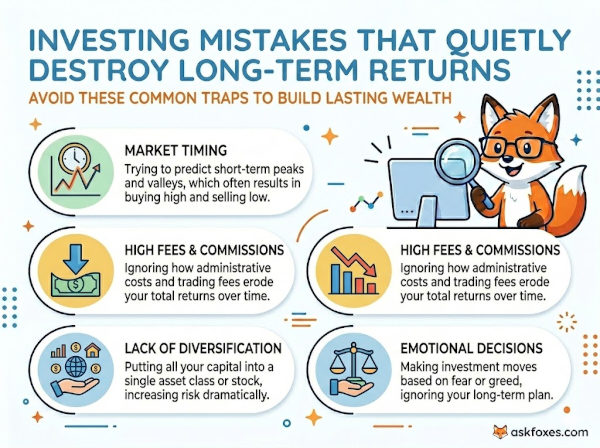
Mistake #1: Emotional Buying and Panic Selling
One of the most common beginner investing errors is reacting emotionally to market movements.
When prices rise rapidly, inexperienced investors often buy out of fear of missing out.
When markets crash, those same investors panic and sell at losses.
This creates the classic destructive cycle:
2. Investor buys emotionally
3. Market corrects downward
4. Fear takes over
5. Investor sells at a loss
6. Market eventually recovers without them
Over time, repeated emotional reactions severely damage long-term returns.
Mistake #2: Ignoring Investment Fees
Many beginners focus entirely on investment performance while ignoring fees.
This is a major mistake.
Even small annual management fees quietly consume massive amounts of long-term wealth through compounding.
| Portfolio Size | 1% Annual Fee Over 30 Years | Potential Wealth Lost |
|---|---|---|
| $50,000 | $57,000+ | Extremely High |
| $100,000 | $114,000+ | Severe |
| $250,000 | $285,000+ | Massive |
| $500,000 | $570,000+ | Life-Changing |
High fees silently attack portfolios every single year — regardless of whether the market rises or falls.
Mistake #3: Constantly Checking the Portfolio
Many beginner investors obsessively monitor daily market movements.
This usually increases stress, impulsive trading, and emotional decision-making.
Ironically, constantly watching investments often leads to worse long-term outcomes.
Long-term investing works best when investors think in years — not hours.
Mistake #4: Lack of Diversification
Some beginners invest too heavily into:
- A single stock
- One industry sector
- Trending companies
- Popular social media recommendations
- Speculative “hot” assets
This creates concentrated risk.
If one investment performs poorly, the entire portfolio can suffer catastrophic damage.
Mistake #5: Trying to Predict Market Timing
Many investors wait endlessly for the “perfect entry point.”
They believe:
- The market will crash tomorrow
- Prices are currently “too high”
- A better opportunity is coming soon
Unfortunately, predicting short-term market movements consistently is extremely difficult — even for professionals.
While waiting on the sidelines, investors often miss years of growth.
The Smarter Alternative: Dollar-Cost Averaging
Instead of trying to predict perfect timing, many long-term investors use a consistent investing system.
2. Continue during market highs
3. Continue during market crashes
4. Ignore short-term volatility
5. Allow compounding to work over decades
This strategy removes emotion and reduces timing risk significantly.
Mistake #6: Following Social Media Investment Hype
Modern investing culture is heavily influenced by viral financial content.
Social media often promotes:
- Unrealistic profit expectations
- High-risk speculation
- Short-term gambling behavior
- Extreme leverage strategies
- “Get rich quick” narratives
Most viral investing stories highlight winners while hiding the thousands of people who lost money following the same strategy.
Mistake #7: Selling During Market Crashes
Market crashes feel terrifying in real time.
However, historically, major market declines have eventually recovered over long periods.
The investors who suffer the most damage are often those who:
- Sell after large declines
- Lock in temporary losses permanently
- Miss the eventual recovery phase
Some of the best long-term investing opportunities historically appeared during periods of maximum fear.
The Psychology Behind Long-Term Investing Success
Successful investing is often less about intelligence and more about behavior.
The best long-term investors typically share several characteristics:
- Patience
- Consistency
- Emotional control
- Long-term thinking
- Risk awareness
Most investing failures happen not because markets are unpredictable — but because human emotions are.
The Smart Investor’s Final Rule
Most investing success comes from avoiding catastrophic mistakes rather than finding magical opportunities.
Long-term wealth building is usually boring, slow, and emotionally uncomfortable at times.
But investors who avoid panic, reduce fees, stay diversified, and remain consistent often outperform people constantly chasing shortcuts.
Because in investing, small habits repeated for decades matter far more than temporary moments of brilliance.