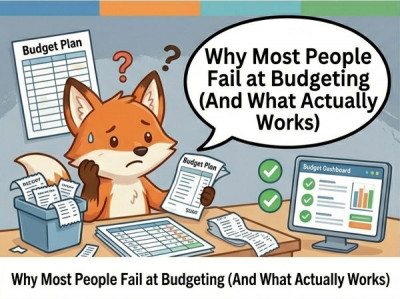
Why Most People Fail at Budgeting (And What Actually Works)
Most people try budgeting at least once in their lives.
They download a spreadsheet, create spending categories, set limits, and feel motivated for a few days.
Then reality takes over.
Tracking becomes annoying, categories become confusing, and overspending slowly returns.
This is why traditional budgeting methods often fail—not because people are careless, but because the system is not designed for real human behavior.
The Main Reason Most Budgets Fail
The biggest problem is not discipline—it is complexity.
When budgeting requires constant tracking and decision-making, people naturally abandon it.
Common failure points include:
- Too many spending categories
- Manual tracking fatigue
- Unrealistic spending limits
- Inconsistent income handling
- Emotional spending triggers
The more effort a system requires, the less likely it is to survive long-term.
The Psychology Behind Budget Failure
People do not fail budgets because they don’t understand money.
They fail because behavior is driven by convenience, emotion, and habits—not spreadsheets.
Budgeting systems often ignore:
- Impulse spending behavior
- Stress-based purchases
- Social spending pressure
- Delayed gratification difficulty
Without addressing behavior, numbers alone are not enough.
Why Tracking Every Expense Doesn’t Work
One of the most common budgeting methods is detailed expense tracking.
While it seems logical, it often fails in practice.
Problems include:
- Time-consuming logging
- Loss of motivation over time
- Small purchases going untracked
- Inaccurate data entry
Eventually, people stop tracking altogether.
Once tracking stops, the system breaks down completely.
The Simpler Alternative: Rule-Based Budgeting
Instead of tracking every expense, successful systems rely on simple rules.
Rules are easier to follow than categories because they reduce decision-making.
Examples include:
- Save a fixed percentage of income automatically
- Limit discretionary spending per week
- Avoid lifestyle inflation after income increases
- Use separate accounts for savings and spending
These rules operate without constant monitoring.
The Power of Automatic Savings
One of the most effective financial habits is automation.
Instead of deciding to save money each month, the system does it automatically.
Benefits include:
- No decision fatigue
- Consistent saving behavior
- Reduced temptation to overspend
- Long-term wealth building
Automation removes emotional interference from saving decisions.
The 3-Account System That Actually Works
A simple structure often works better than complex budgets.
| Account Type | Purpose |
|---|---|
| Income Account | Receives salary or earnings |
| Spending Account | Daily expenses and lifestyle costs |
| Savings Account | Long-term financial growth |
This separation creates natural spending limits without tracking every purchase.
Why “Zero-Based Budgeting” Fails Beginners
Zero-based budgeting assigns every dollar a purpose.
While powerful in theory, it often fails beginners due to complexity.
Common issues include:
- Too much planning required every month
- Frequent adjustments needed
- Difficulty handling unexpected expenses
It works better for advanced users than beginners.
The Real Problem: Lifestyle Inflation
As income increases, spending often increases automatically.
This phenomenon is called lifestyle inflation.
Examples include:
- Upgrading apartments too quickly
- Buying expensive gadgets immediately
- Increasing subscription costs
- Dining out more frequently
Without control, higher income does not always lead to higher savings.
Why Simple Budgets Work Better Long-Term
Simplicity increases consistency.
The most effective financial systems are:
- Easy to understand
- Hard to break accidentally
- Low maintenance
- Based on habits, not tracking
Complex systems fail because they depend on motivation. Simple systems survive because they depend on structure.
The “Pay Yourself First” Principle
One of the most reliable financial strategies is prioritizing savings before spending.
This means treating savings like a non-negotiable expense.
Instead of saving what is left, you spend what is left after saving.
This small shift dramatically improves long-term financial stability.
A Beginner-Friendly Money System
A simple structure that works for most people:
2. Transfer remaining money to spending account
3. Use spending account freely without tracking every expense
4. Avoid touching savings except for emergencies
5. Adjust savings rate gradually over time
This system removes the need for constant budgeting decisions.
The Role of Spending Awareness (Without Obsession)
Awareness is important, but obsession is not necessary.
Instead of tracking everything, focus on:
- Major recurring expenses
- Subscription services
- Impulse spending patterns
- Monthly savings rate
This provides insight without overwhelm.
The Smart Budgeting Mindset
Successful budgeting is not about restriction.
It is about creating a system that naturally supports better decisions.
The goal is not to control every expense, but to design a structure where good financial behavior happens automatically.
The Final Rule of Budgeting
Most budgeting systems fail because they require too much effort and constant attention.
The most effective systems are simple, automated, and behavior-friendly.
When money management becomes invisible in daily life, consistency becomes much easier—and financial progress becomes natural over time.