Quiet Quitting vs Smart Boundary Setting: The Real Difference
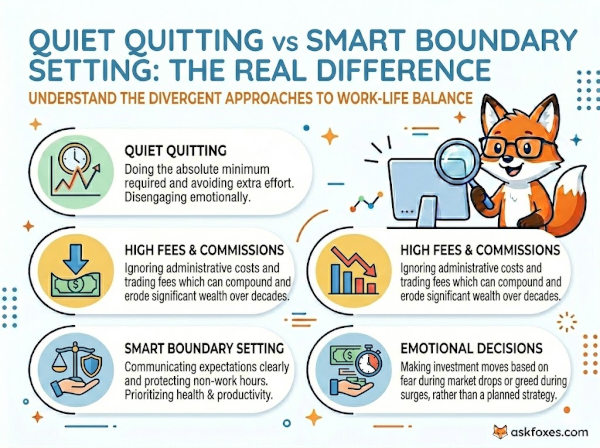
Over the past few years, the phrase “quiet quitting” exploded across social media, workplace discussions, and corporate news headlines.
Some people described it as a rebellion against toxic work culture. Others called it laziness disguised as self-care. But in reality, most employees misunderstand what quiet quitting actually is — and how it differs from smart professional boundary setting.
The confusion matters because one behavior quietly damages long-term career growth, while the other can actually improve productivity, reputation, and mental sustainability.
Understanding the difference is one of the most valuable modern workplace skills professionals can develop.
Why So Many Employees Feel Burned Out
Modern workplace culture often rewards availability more than efficiency.
Many employees slowly fall into unhealthy habits like:
- Answering emails late at night
- Working during vacations
- Accepting unrealistic deadlines
- Taking on unpaid emotional labor
- Constantly saying “yes” to extra work
Initially, these behaviors may appear productive or ambitious.
But over time, they frequently lead to exhaustion, resentment, and declining performance.
The Core Difference Most People Miss
Quiet quitting and healthy boundary setting may appear similar from the outside because both involve reducing unnecessary overwork.
But internally, they are completely different strategies.
| Quiet Quitting | Smart Boundary Setting |
|---|---|
| Emotional disengagement | Intentional energy management |
| Minimal effort mentality | Sustainable performance focus |
| Avoids responsibility entirely | Prioritizes responsibilities strategically |
| Damages professional reputation | Protects long-term career growth |
| Passive withdrawal | Active communication |
The distinction is not about working fewer hours.
It is about whether you remain professionally engaged while protecting your personal limits.
The Hidden Danger of Quiet Quitting
Many employees assume doing the bare minimum protects them from stress.
Short-term, this may feel emotionally relieving.
Long-term, however, quiet quitting often creates invisible career damage:
- Reduced promotion opportunities
- Loss of professional trust
- Weak networking relationships
- Declining skill development
- Poor leadership perception
Managers may not confront disengagement immediately, but they almost always notice it eventually.
What Healthy Boundary Setting Actually Looks Like
Strategic professionals understand that sustainable careers require controlled energy management.
Healthy boundaries often include:
- Protecting personal time after work
- Declining unrealistic workloads respectfully
- Communicating availability clearly
- Taking vacations without guilt
- Prioritizing high-impact tasks
The key difference is that productive employees with boundaries still care about performance and results.
They simply refuse to sacrifice their long-term health to maintain temporary workplace appearances.
The “Always Available” Trap
One of the biggest modern workplace problems is digital overavailability.
Remote work and smartphones blurred the line between professional and personal life.
Many employees now feel pressure to remain permanently reachable.
This creates a dangerous cycle:
2. Availability becomes expected
3. Boundaries slowly disappear
4. Workload increases further
5. Burnout begins developing
6. Motivation declines dramatically
Without intentional boundaries, work can quietly expand into every area of life.
Why High Performers Often Struggle With Boundaries
Ironically, ambitious employees are often the most vulnerable to burnout.
High performers frequently:
- Take excessive responsibility
- Feel guilty saying no
- Fear appearing uncommitted
- Tie self-worth to productivity
- Overextend themselves repeatedly
This can create a dangerous identity loop where rest begins to feel “unproductive.”
Over time, performance quality usually declines anyway.
The Smart Professional’s Communication Strategy
Boundary setting works best when communicated strategically and professionally.
Poor communication sounds defensive or emotional.
Strong communication sounds clear, collaborative, and solution-oriented.
Weak Boundary Communication
Strategic Boundary Communication
The second approach protects workload limits while still appearing professional and cooperative.
How Managers Often Misinterpret Boundaries
Some workplaces still associate boundaries with lack of commitment.
This is especially common in:
- High-pressure corporate environments
- Startup cultures
- Understaffed teams
- Performance-driven industries
However, experienced leaders increasingly recognize that burned-out employees become less productive, less creative, and more likely to quit entirely.
| Burned-Out Employee | Employee With Healthy Boundaries |
|---|---|
| Emotionally exhausted | Mentally sustainable |
| Reactive under pressure | More focused and consistent |
| Declining productivity | Stable long-term performance |
| High turnover risk | Better retention potential |
| Lower engagement | Strategic engagement |
The Career Cost of Constant Overworking
Many professionals assume endless hard work automatically creates career success.
In reality, chronic overworking can damage:
- Decision-making quality
- Creativity
- Communication ability
- Physical health
- Long-term motivation
Sustainable performance almost always outperforms temporary overexertion across long careers.
The Smart Employee’s Final Rule
Quiet quitting is withdrawal.
Smart boundary setting is optimization.
One disconnects emotionally from professional growth. The other protects the energy required to continue growing sustainably.
The goal is not to become emotionally detached from work entirely.
The goal is learning how to contribute professionally without allowing work to quietly consume your entire identity, health, and personal life.