Best Digital Products With High Profit Margins
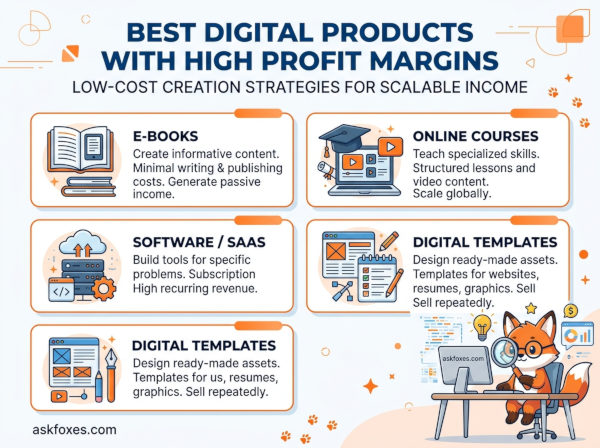
One of the biggest advantages of the internet economy is the ability to sell products that never run out of stock.
No warehouses. No shipping logistics. No manufacturing delays.
Just a digital file that can be sold repeatedly to unlimited customers around the world.
This is why digital products have become one of the most attractive business models for creators, freelancers, entrepreneurs, and side hustlers.
Once created, many digital products can generate revenue for months or even years with very little ongoing cost.
Why Digital Products Are So Profitable
Traditional businesses usually face major operational expenses:
- Manufacturing costs
- Shipping fees
- Inventory storage
- Supply chain problems
- Physical production scaling
Digital products remove most of these limitations completely.
After the initial creation process, additional sales often cost almost nothing.
The Most Profitable Types of Digital Products
Not every digital product performs equally well.
The highest-margin products usually solve expensive problems, save time, or help people earn money faster.
| Digital Product Type | Startup Difficulty | Profit Margin Potential | Scalability |
|---|---|---|---|
| Ebooks | Low | Very High | High |
| Online Courses | Medium | Extremely High | Very High |
| Templates & Toolkits | Low | Very High | High |
| Software & Apps | High | Massive | Extreme |
| Membership Communities | Medium | Recurring Revenue | Very High |
Why Templates Quietly Dominate Online Sales
One of the most underrated digital product categories is templates.
People constantly search for shortcuts that save time.
Popular examples include:
- Resume templates
- Budget spreadsheets
- Notion dashboards
- Canva social media kits
- Business proposal templates
- Email marketing sequences
Templates are powerful because customers are not just buying files.
They are buying speed, simplicity, and reduced mental effort.
The Massive Advantage of Recurring Revenue Products
Some digital products generate one-time sales.
Others create recurring monthly income.
Recurring models are often dramatically more valuable long-term.
| Business Model | Income Stability | Growth Potential |
|---|---|---|
| One-Time Ebook Sales | Moderate | Limited |
| Template Marketplace | High | Strong |
| Subscription Membership | Very High | Excellent |
| Software Subscription | Extremely High | Massive |
This is why so many online businesses eventually transition toward subscriptions or memberships.
The Beginner Mistake: Creating Before Validating
Many beginners spend months building digital products nobody actually wants.
They focus entirely on creation while ignoring market demand.
This creates one of the most common digital business failures.
The Smarter Validation Process
2. Research existing demand
3. Study competitors carefully
4. Create a small minimum version
5. Test audience interest early
6. Improve based on feedback
Successful creators validate demand before investing massive amounts of time.
Why Educational Products Sell So Well
People are constantly trying to improve:
- Career skills
- Financial knowledge
- Fitness results
- Productivity systems
- Creative abilities
This creates enormous demand for educational digital products.
Courses, guides, tutorials, and skill-based resources remain some of the internet’s most profitable assets.
The “Low Ticket vs High Ticket” Decision
Digital creators often choose between two pricing strategies:
- Low-cost products sold at high volume
- Premium products sold to smaller audiences
Both models can work.
| Strategy | Typical Price | Best Advantage | Main Challenge |
|---|---|---|---|
| Low-Ticket Products | $5 - $50 | Easier impulse purchases | Requires larger audience |
| High-Ticket Products | $200 - $5,000+ | Higher revenue per customer | Requires stronger trust |
Many successful creators eventually combine both models together.
How Digital Products Create Passive Income
Digital income is often called “passive,” but this can be misleading.
Most successful products require significant upfront work:
- Research
- Creation
- Marketing
- Audience building
- Customer support
However, unlike hourly work, digital assets can continue generating revenue after the original labor is complete.
This creates scalability traditional jobs rarely provide.
The Most Profitable Digital Product Niches
Certain industries consistently outperform others because they solve financially valuable problems.
High-Demand Niches
- Personal finance
- Career advancement
- Business systems
- Fitness & health
- AI productivity tools
- Content creation
- Marketing automation
People spend money fastest when products:
- Save time
- Reduce stress
- Increase income
- Improve status
- Solve painful frustrations
The Distribution Problem Most Creators Ignore
Creating a product is only half the challenge.
Distribution matters equally.
Many excellent digital products fail because nobody discovers them.
That is why successful creators often prioritize:
- Email lists
- SEO traffic
- Social media audiences
- YouTube channels
- Online communities
- Affiliate partnerships
Audience attention has become one of the most valuable online business assets.
The Hidden Power of Small Digital Products
Many beginners believe they need massive online courses or complex software to succeed.
In reality, small focused products often perform better because they:
- Solve one clear problem
- Require less customer commitment
- Are easier to market
- Can be created quickly
- Generate faster feedback loops
Simple products frequently outperform overly complicated ones.
The Smart Creator’s Final Rule
The internet rewards scalable value creation.
Digital products are powerful because they separate income from direct hourly labor.
But the most profitable creators usually focus less on “making money online” and more on solving specific problems efficiently.
Because when a digital product genuinely saves people time, stress, or effort, customers often return repeatedly — and recommend it to others automatically.