Print-on-Demand vs Etsy Digital Products: Which Makes More Money?
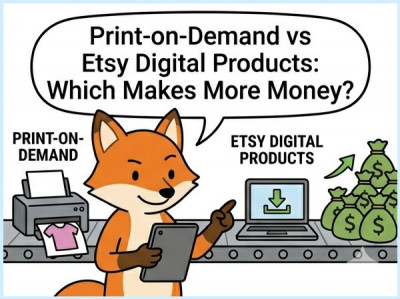
Two of the most popular online side hustles today require little upfront investment and can be started from almost anywhere in the world.
Print-on-Demand (POD) and Etsy digital products have attracted millions of creators looking to generate income without holding inventory, renting office space, or managing complicated logistics.
Both business models promise flexibility, scalability, and the possibility of earning money while you sleep.
However, they operate very differently.
Understanding the strengths, weaknesses, and earning potential of each model can help you choose the path that best matches your skills and goals.
Why These Two Side Hustles Are Often Compared
At first glance, both models seem remarkably similar.
- No inventory storage
- Low startup costs
- Online sales
- Creative flexibility
- Global customer reach
But the economics behind each business are very different.
The key question is not which model is easier.
The key question is which model creates more profit for the effort invested.
How Print-on-Demand Works
With POD, a creator designs products and uploads artwork to a platform.
When a customer places an order:
2. POD provider prints item
3. Provider packages order
4. Provider ships order
5. Creator receives profit margin
The creator never handles inventory or shipping.
This simplicity is one of POD's biggest advantages.
How Etsy Digital Products Work
Digital products follow a different process.
Once a product is created and listed:
2. Etsy delivers product automatically
3. Customer downloads instantly
4. Creator receives payment
No manufacturing.
No shipping.
No fulfillment delays.
The product can be sold repeatedly without additional production costs.
The Profit Margin Comparison
This is where the difference becomes significant.
| Factor | Print-on-Demand | Etsy Digital Products |
|---|---|---|
| Production Cost | Required Per Sale | Usually None |
| Shipping Cost | Required | None |
| Inventory Cost | None | None |
| Profit Margin | Moderate | Very High |
| Scaling Cost | Increases With Sales | Nearly Zero |
Digital products generally offer dramatically higher profit margins because there are almost no variable costs after creation.
Why Digital Products Often Win on Profitability
Imagine selling a printable budget planner for $15.
After platform fees, most of the remaining revenue may become profit.
Now compare that with a POD t-shirt sold for $25.
The creator must account for:
- Printing costs
- Shipping costs
- Platform fees
- Advertising costs
The final profit per sale may be substantially lower.
This is one reason many experienced online entrepreneurs eventually transition toward digital products.
Startup Difficulty: Which Is Easier?
The answer depends on your skills.
| Skill Requirement | Print-on-Demand | Digital Products |
|---|---|---|
| Graphic Design | Moderate | Moderate |
| Market Research | Important | Important |
| Technical Knowledge | Low | Moderate |
| Product Creation Time | Lower | Higher |
| Customer Support | Moderate | Usually Low |
Simple POD designs can often be launched quickly.
High-quality digital products usually require more upfront work.
Which Model Scales Better?
Scalability is where digital products become extremely attractive.
A digital file can be sold:
- 10 times
- 100 times
- 1,000 times
- 10,000 times
Without requiring additional production.
A POD business, by contrast, generates production costs on every sale.
Both can scale, but digital products often scale more efficiently.
The Competition Problem
Both markets are highly competitive.
However, competition appears differently.
Print-on-Demand Competition
- Massive product selection
- Trend-based markets
- Fast imitation of designs
- Price pressure
Digital Product Competition
- Template saturation
- Search ranking challenges
- Quality expectations
- Niche specialization requirements
Success usually comes from solving specific customer problems rather than creating generic products.
The Power of Problem-Solving Products
Many beginners focus on making products they personally like.
Successful sellers focus on products people actively search for.
Examples of High-Demand Digital Products
- Budget spreadsheets
- Resume templates
- Business planners
- Social media templates
- Notion dashboards
- Wedding planning kits
Customers often pay for convenience more readily than creativity.
Customer Service Considerations
POD sellers occasionally face issues such as:
- Shipping delays
- Lost packages
- Printing defects
- Return requests
Digital product sellers usually encounter fewer operational problems.
Most support requests involve:
- Download assistance
- File access issues
- Usage questions
This often makes digital products easier to manage long term.
The Marketing Challenge Both Models Share
Neither business succeeds simply because products exist.
Traffic is essential.
Most successful sellers invest time into:
- SEO
- Pinterest marketing
- Email lists
- Social media content
- Audience building
The distribution strategy often matters more than the product itself.
Passive Income Reality Check
Both POD and digital products are frequently marketed as passive income opportunities.
The reality is more nuanced.
Successful stores typically require:
- Research
- Product creation
- Optimization
- Customer support
- Marketing
Income becomes more passive over time, but substantial upfront effort is usually required.
Which Business Is More Beginner-Friendly?
For complete beginners, POD may feel simpler because product creation can be relatively fast.
Digital products often require deeper understanding of customer needs.
However, once a digital product gains traction, profit margins frequently become more attractive.
| Goal | Better Choice |
|---|---|
| Quick Launch | Print-on-Demand |
| Highest Margins | Digital Products |
| Minimal Customer Issues | Digital Products |
| Physical Product Brand | Print-on-Demand |
| Long-Term Scalability | Digital Products |
The Smart Hybrid Strategy
Many experienced creators eventually combine both models.
For example:
- Sell planners as digital downloads
- Offer matching printed journals through POD
- Create printable artwork and physical poster versions
- Bundle templates with branded merchandise
This creates multiple revenue streams while serving different customer preferences.
The Final Verdict
If the goal is maximizing profit margins, digital products generally win.
They require no inventory, no shipping, and almost no ongoing production costs after creation.
If the goal is building a physical-product brand with lower upfront creation requirements, Print-on-Demand remains an attractive option.
Ultimately, the most successful side hustle is not necessarily the one with the highest theoretical profit margin.
It is the one you can consistently improve, market effectively, and sustain over the long term.
For most creators focused on smart digital income, Etsy digital products offer a stronger path toward scalable profits. But for those who enjoy product branding and design, Print-on-Demand can still become a highly rewarding business model.