Wholesale vs. Retail: Which Household Items Are Actually Cheaper to Buy in Bulk?
Walking into a wholesale warehouse club like Costco or Sam's Club feels like a masterclass in financial efficiency. You see a giant box of cereal or a massive stack of paper towels, calculate the abstract concept of "value," and immediately drop it into your oversized cart. But if you aren't bringing a calculator and an understanding of human psychology to the aisles, buying in bulk can actually end up costing you more than shopping at a standard retail supermarket.
Welcome to The Unit-Price Exploits. Wholesale clubs rely on a specific cognitive bias: they trick your brain into assuming that a larger package automatically equals a lower price per unit. In reality, retail stores frequently run hyper-optimized loss-leader sales that beat wholesale prices out of the water. Today, we will break down the exact mathematical blueprint of what to buy in bulk and what to leave on the retail shelves.
The Expiration Trap: The Psychology of Bulk Waste
The biggest hidden cost of wholesale shopping isn't the upfront price tag; it's waste. If you buy a massive 64-ounce jar of gourmet mayonnaise for 30% less per ounce than the retail version, but you end up throwing away the final third of the jar because it expires before you can finish it, you didn't save 30%. You mathematically lost money. Liquid assets turn into liabilities the second they pass their expiration threshold.
The Bulk Shopping Blueprint: What to Stash vs. What to Pass
To successfully navigate a warehouse club like a true digital fox, categorize your household needs into these two strict operational streams:
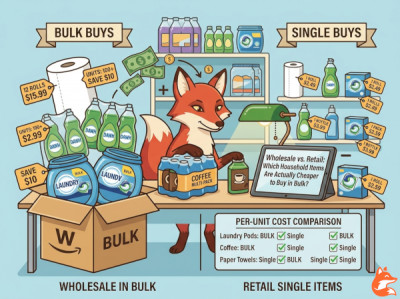
- Always Buy in Bulk (Non-Perishable / High-Use): Target items with infinite or multi-year shelf lives. Toilet paper, paper towels, trash bags, laundry detergent sheets, batteries, and solid bar soaps should always be sourced from wholesale networks. The unit price on these items is consistently 20% to 40% lower than retail.
- Never Buy in Bulk (Rapidly Degrading / Low-Use): Avoid giant containers of spices (they lose their volatile oils and flavor potency after 6 months), brown rice (it contains natural oils that go rancid much faster than white rice), condiments, and over-the-counter medications like a 500-count bottle of ibuprofen (unless you have a family of ten, it will expire long before the bottle is empty).
- The Canned and Dry Goods Middle Ground: Canned beans, dry pasta, and oats are excellent bulk purchases, provided you have the physical, climate-controlled storage space to prevent pest infestation or moisture breakdown.
Real-World Breakdown: Unit Price Comparison
Let's map out the real-world mathematical variance between standard retail grocery setups and typical wholesale club environments across major household categories.
| Household Item | Wholesale Advantage | The Math / Unit Reality | Strategic Decision |
|---|---|---|---|
| Trash Bags & Paper Utilities | Very High (35% - 45% Savings) | Infinite shelf life; drastically lower cost per sheet/bag. | **ALWAYS BULK** |
| Premium Ground Coffee | Medium (15% - 20% Savings) | Degrades within 3-4 weeks of opening due to oxidation. | **RETAIL ONLY** (Buy fresh) |
| Cereal & Dry Snacks | Low (5% - 10% Savings) | Retail stores frequently beat bulk prices via coupon stacking. | **COMPARE TAGS** |
| Batteries (AA/AAA) | High (30% Savings) | Shelf life of up to 10 years; wholesale packs offer massive ROI. | **ALWAYS BULK** |
How to Exploit Wholesale Clubs Without Paying a Membership Fee
If you only need to buy bulk items three or four times a year, paying a $60 to $110 annual warehouse membership fee instantly wipes out your structural savings. You have two backup optimization options to bypass the paywall entirely:
1. Use the Instacart / Third-Party Delivery Loophole
Many wholesale clubs partner with digital delivery networks. On platforms like Instacart, you can shop the entire inventory of certain warehouse clubs without entering a member ID number. While the app occasionally applies a minor markup per item, the total cost is often significantly lower than paying for an annual membership card if you are only running a biannual household stock-up mission.
2. Deploy the "Gift Card Extraction" Protocol
By corporate policy, major warehouse clubs like Costco cannot legally deny entry to someone carrying a valid cash card or gift card issued by their store. If you have a friend who is a member, ask them to purchase a $25 gift card for you. Walk past the security gate using this exact conversational script:
IF presentation_asset == "Store_Gift_Card" THEN
SET gate_access = TRUE; EXECUTE_WALK_IN;
ELSE
PROMPT -> "Show Membership Card";
END IF;
END FUNCTION;
Once inside, you are legally permitted to fill your cart and complete your purchase at the register. The system will spend down the $25 balance on the card first, and you can simply clear the remaining balance using your standard debit card or cash—bypassing the subscription model entirely while capturing pure wholesale price-per-unit value.