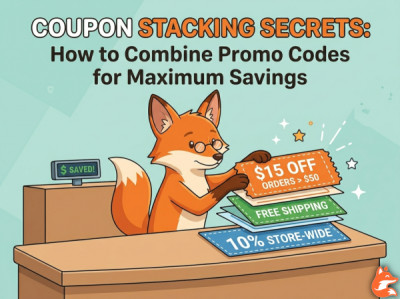
Coupon Stacking Secrets: How to Combine Promo Codes for Maximum Savings
We have all tried it. You find an online store that has a 15% off coupon box at checkout. You type in your code, see the price drop, and then immediately try to paste a second code for free shipping or an extra $10 off. In 95% of cases, the store's system flashes a frustrating error message: "Promo codes cannot be combined for this order." E-commerce platforms build these digital walls on purpose to protect their profit margins.
Welcome to The Coupon Compound Protocol. While retail algorithms are programmed to block basic, multiple-coupon entry, there are hidden structural loopholes in checkout engines that allow you to layer discounts legally. By understanding code hierarchies and stacking methods, you can force automated carts into compounding your savings. Today, we leak the stacking blueprint.
Decoding the E-Commerce Code Hierarchy (The Rules of the Game)
To successfully stack discounts, you must stop treating all coupon codes equally. Digital retail checkout systems process promotional inputs based on an internal sequence of operations. If you input your codes in the wrong order, the system's defensive logic will immediately override your previous savings.
The Stacking Order Blueprint
To ensure your compounding discounts pass through the digital checkout gates without triggering an automated block, follow this exact sequence:
- Layer 1: The Sitewide Automatic Discount. Always start with base-level promotions that do not require a code input (e.g., automated sitewide holiday sales). The cart calculates this baseline deduction automatically.
- Layer 2: The Item-Specific or Manufacturer Code. Apply codes that target a specific SKU or product category inside your cart next. Because this code only binds to a fraction of the total basket, the checkout engine rarely flags it as a conflict with sitewide promotions.
- Layer 3: The Account-Level or Loyalty Reward Code. Paste your personalized user coupon (like a sign-up bonus, birthday discount, or abandoned cart reward). Retail systems treat these as alternative currencies rather than promotional codes, allowing them to stack seamlessly.
- Layer 4: The Transaction-Level Shipping Code. Always save the free shipping promo code for the absolute final step. Shipping waivers bind to the logistical delivery matrix rather than the inventory asset, letting them clear the cart without deleting previous item price drops.
Real-World Effectiveness: Stacking Permutations Compared
Not every e-commerce engine uses the same digital logic framework. Understanding the baseline behavior of major shopping systems allows you to deploy the right exploitation tactics instantly.
| E-Commerce Platform Engine | Stacking Likelihood | Native Loophole Behavior |
|---|---|---|
| Shopify Ecosystem | Medium (50%) | Allows stacking only if the merchant explicitly enables "Combinations" in backend settings. |
| WooCommerce (WordPress) | High (80%) | Frequently vulnerable to overlapping native codes with third-party loyalty point triggers. |
| Custom Big-Retail Engines | Very High (90%) | Allows stacking store rewards certificates, gift cards, and promotional codes in a single path. |
| Amazon Native Checkout | Low (20%) | Rarely lets promo codes stack, but allows clipping native coupons alongside active lightning sales. |
What to Do If the Digital Cart Blocks Your Codes?
If you input your secondary code and the screen locks you out with a "cannot combine" warning, the store's engineering team has successfully sealed the standard code loophole. Don't panic; you can still force a compound markdown using the digital double-dip framework:
1. Weaponize the Digital Gift Card Detour
If a platform permits only one promo code per transaction but allows you to pay using gift cards, use your first promo code on a secondary account to buy a digital store gift card at a discount. Once received, return to your primary account, apply your second promo code to your actual shopping cart, and use the discounted gift card to settle the remaining balance at checkout. You have successfully bypassed their coupon limits via payment abstraction.
2. Deploy the "Double-Agent" Stacking Script
Before hitting the final purchase confirmation, run a quick background check using browser network monitoring or automated extension scrapers to see if any untracked database codes bypass the platform's constraints. You can visualize the filtering logic using this exact automated sorting loop:
TRY_INPUT -> layer_1_code AND layer_2_code;
IF checkout_response == "SUCCESS" THEN
CALCULATE compounding_depth;
STORE_OPTIMAL_SEQUENCE -> priority: high;
ELSE
EXECUTE_CLEAN_CART_RESET;
END IF;
END FOR;
By enforcing a calculated, systematic sequence of operations on your shopping carts and leveraging the gift card detour, you break through artificial retail boundaries—retaining your hard-earned capital and capturing elite, compound savings on every single delivery box that lands at your doorstep.