The Cash Envelope System: How This Old-School Hack Stops Overspending
We have all experienced the digital phantom effect. You swipe your credit card, tap your phone against a terminal, or click a single biometric button to finalize an online purchase. Because no physical currency leaves your hands, your brain fails to register the financial loss. By the end of the month, you look at your digital banking statement and wonder how dozens of minor taps aggregated into a massive budget deficit. But what if you could hack your own psychology to make overspending completely impossible?
Welcome to The Cash Envelope System Blueprint. While fintech corporations spend billions trying to frictionlessly detach you from your money, the most powerful weapon against modern consumer debt is a simple, old-school analog technique. By forcing physical boundaries onto your discretionary cash flow, you stop relying on willpower and let mathematics run your lifestyle. Today, we will show you exactly how to configure this tactical cash system to regain absolute control of your monthly earnings.
The Frictionless Spending Trap: The Psychology of Modern Plastic
Neuroscientific studies consistently reveal that paying with credit cards or digital wallets fails to activate the "pain centers" of the human brain. Plastic removes the immediate consequence of consumption. When you switch to physical cash, the tactile experience of counting bills and handing them over to a cashier creates immediate psychological resistance. You become hyper-aware of every single dollar leaving your possession, instantly eliminating impulse purchases that bypass your long-term financial plans.
The 4-Step Action Plan to Deploy Your Envelope Framework
To successfully transition your variable expenses into an airtight cash envelope ecosystem without disrupting your fixed bill payments, execute this systematic protocol:
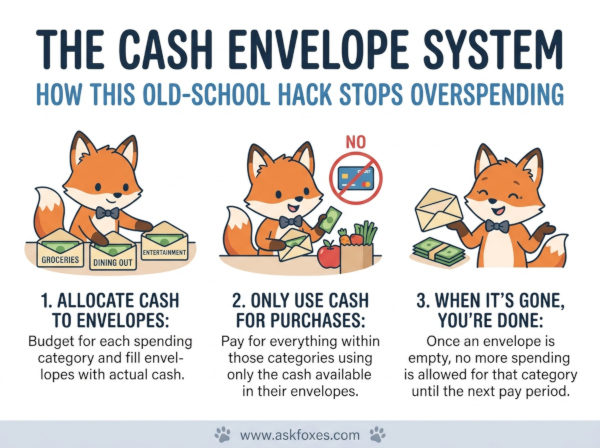
- Step 1: Isolate Your Variable Spending Categories. Do not put your fixed rent, insurance, or utility bills into envelopes; leave those on automated electronic drafts. Focus exclusively on fluid, easily inflated categories like groceries, restaurants, clothing, beauty, and weekend entertainment.
- Step 2: Establish Strict Monthly Cash Caps. Look at your net income and subtract your fixed bills and savings goals. Take the remaining discretionary pool and distribute it logically across your variable categories based on historical statement data.
- Step 3: Make a Strategic ATM Withdrawal on Payday. The exact day your paycheck clears, go to a local ATM and withdraw the total cash amount needed to fund your variable categories for the upcoming cycle. Do not split this step into multiple trips.
- Step 4: Distribute and Label Your Physical Envelopes. Place the cash into dedicated paper envelopes explicitly marked with the category name and its total allowance. Leave your plastic debit and credit cards locked at home, carrying only the specific envelopes required for your daily errands.
Budget Allocation: Cash vs. Automated Electronic Drafts
To keep your financial layout clean, you must draw a distinct line between structural overhead that belongs in the digital space and fluid costs that belong in physical paper.
| Expense Type | Best Financial Medium | The Strategic Reasoning |
|---|---|---|
| Rent / Mortgage / Car Payments | Automated Digital ACH | Fixed contractual amounts that carry zero risk of emotional inflation. |
| Groceries & Household Consumables | Physical Cash Envelope | Prevents impulse brand switching and gourmet grocery aisle spending spikes. |
| Dining Out / Cafes / Bars | Physical Cash Envelope | Provides an absolute visual cutoff line during weekend social gatherings. |
| Subscription Services (Streaming) | Virtual Credit Card | Requires automated digital handshakes but can be capped at a specific spending limit. |
The "Empty Envelope" Pivot Strategy
The true magic of this system happens the moment you open an envelope on a Friday night and discover there is only a single $5 bill left inside. To manage this boundary without breaking the rules or abandoning the system, deploy one of these two operational maneuvers:
1. The Zero-Cost Entertainment Substitution
When your dining or entertainment envelope hits zero before the week ends, do not slide your credit card out of your wallet. Force your lifestyle to adapt to the envelope boundary. Use this exact mental frame to pivot your social scheduling:
This strict rule structure trains your brain to treat the paper boundary as a physical wall, forcing you to discover free local activities that keep your savings fully insulated.
2. The Inter-Envelope Trade Protocol
If you face an urgent situation where you absolutely must spend money in an exhausted category (such as running out of essential medicine within your personal care pool), you can execute an official administrative trade. Sit down with your envelopes and follow this communication logic:
By forcing yourself to physically take cash out of a desirable category (like shopping) to cover an overage elsewhere, you feel the immediate cost of your trade. This maintains your overarching financial integrity and prevents the toxic habit of borrowing against your future credit card limits.