The Psychology of Lifestyle Creep: Why You Feel Poor Despite Earning More
It is one of the most jarring realizations in adult life. You finally land that long-awaited promotion, secure a major raise, or successfully scale your income streams. On paper, you should be breathing easily, building a massive investment cushion, and watching your savings account surge. Yet, three months into your new tax bracket, the familiar chest-tightening anxiety returns. You look at your checking balance a day before payday and realize you are still skating dangerously close to the edge. Where did the money go?
Welcome to The Psychology of Lifestyle Creep. In behavioral economics, this phenomenon is known as lifestyle inflation—the gradual, almost invisible increase in your discretionary spending as your income rises. It is not a symptom of low intelligence or poor math skills; it is a direct consequence of how the human brain is wired to process comfort, novelty, and social status. Today, we will deconstruct the evolutionary and cognitive traps that keep you feeling broke, and provide an actionable psychological framework to break the cycle for good.
The Cognitive Vulnerabilities That Inflate Your Budget
To defeat lifestyle creep, you must understand the mental software updates that occur the moment your income shifts upward. Your brain utilizes specific shortcuts to justify increased spending, hiding the long-term cost of minor comfort upgrades.
1. Behavioral Anchoring and the Shift of "Necessity"
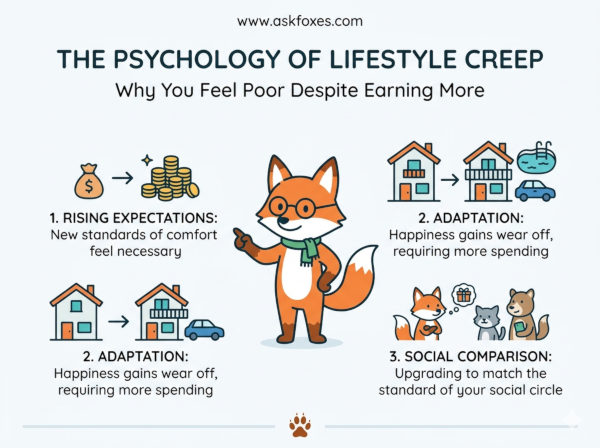
When your income increases, the psychological phenomenon of anchoring shifts. If you used to anchor your grocery budget to affordable house brands, a higher income alters your baseline. Suddenly, premium organic groceries, regular subscription boxes, and convenient rideshare apps stop feeling like special treats—they are reclassified by your brain as fundamental baseline requirements for your daily routine. You aren't "splurging"; you are simply living your new normal.
2. Social Mimicry and Peer-Group Drift
As your career advances, your professional and social environments shift. Humans are evolutionary herd animals; we unconsciously mirror the consumption habits of the people around us to maintain tribal belonging. When your peers start booking expensive weekend trips, dining at high-end venues, or driving newer vehicles, your brain views matching that consumption level not as vanity, but as a survival mechanism for social integration.
The Mechanics of Lifestyle Creep: Income vs. Asset Accumulation
The primary trap of lifestyle inflation is confusing a high cash-flow income with genuine, long-term wealth. When your spending matches your earning curve step-for-step, your net worth stays stagnant.
| Financial Vector | The Consumer Trap Scenario | The Smart Fox Alignment |
|---|---|---|
| Salary Increase Handling | Discretionary spending rises immediately to match the new net intake. | The extra cash is redirected into wealth-generating assets before it hits the checking account. |
| Convenience Subscriptions | Stacking automated services (meal kits, cloud storage, streaming tiers) without auditing. | Capping recurring subscriptions to a fixed, intentional percentage of baseline overhead. |
| Big-Ticket Upgrades (Cars/Homes) | Maximizing debt capacity based on the absolute highest monthly payment you can afford. | Maintaining standard, low-overhead fixed costs to preserve liquid capital for investing loops. |
| Psychological Outcome | Perpetual Anxiety: Feeling stuck living paycheck to paycheck despite high earnings. | Financial Autonomy: Peaceful stability derived from a wide gap between income and expenses. |
The 4-Step Action Plan to Implement a "Hedonic Speed Limit"
To successfully break out of the hedonic trap and ensure that your next financial upgrade permanently increases your net worth, execute this systematic behavioral framework:
- Step 1: Practice "Reverse Budgeting" through Automation. The single most effective psychological defense is to remove human willpower from the equation entirely. The exact day a raise or bonus hits your account, automate a rule that routes 50% of the net increase directly into your retirement or brokerage accounts. If you never see the cash in your main checking account, your brain cannot anchor it to daily spending.
- Step 2: Calculate Purchases in "Hours Worked." Stop looking at price tags in flat dollar amounts. Instead, divide the cost of a luxury upgrade by your net hourly wage. When you realize that a premium dinner out or an aesthetic wardrobe upgrade requires sacrificing 15 hours of your life energy at your desk, the psychological cost shifts dramatically, prompting immediate mindful friction.
- Step 3: Run a Biannual "Subscription and Luxury Audit." Every six months, pull your itemized account PDFs. Look specifically for small convenience leaks—app memberships, automated delivery fees, or premium tiers that you signed up for during a high-income phase but no longer actively maximize. Aggressively cancel them to reset your baseline comfort settings.
- Step 4: Shift from Material Benchmarks to Autonomy Milestones. Reframe what success looks like in your internal monologue. Instead of tying your career progress to physical status symbols (like a luxury watch or a vehicle upgrade), tie your milestones to the buying power of freedom: "Six months of living expenses secured," "One year of professional runway established," or "Passive dividend income covering my monthly groceries".
"The real measure of your wealth is how much you'd be worth if you lost all your money." — Intentional Wealth Principle
The Internal Monologue Re-Anchoring Protocol
When you feel the creeping psychological pressure to elevate your lifestyle simply because your bank account can sustain the transaction, you must actively rewrite your cognitive script. Do not let commercial marketing frameworks define your standard of comfort. Deploy this exact psychological centering frame whenever you audit your personal finances:
By shifting your psychological validation away from visible consumption and toward invisible financial sovereignty, you stop running on the exhausting, endless hedonic treadmill. You stop feeling poor on a higher salary because you realize the ultimate luxury isn't owning premium things—it is owning absolute control over your own time.