The Snowball vs. Avalanche Method: Which Debt Payoff Strategy Is Best for You?
Debt can feel like an anchor holding your entire financial life in place. Every month, your hard-earned income vaporizes into a cloud of minimum payments, high interest rates, and multi-year credit balances. You want to break free, but when you sit down with your statements, the sheer number of open accounts feels completely overwhelming. Most people know they need to pay more than the minimums, but they stumble on the execution strategy. Should you target the smallest balance first, or attack the account with the highest interest rate?
Welcome to The Ultimate Debt Payoff Showdown. In personal finance, the path to becoming debt-free isn't a one-size-fits-all equation. It is a balancing act between mathematical optimization and human behavioral psychology. The two primary weapons used to destroy consumer debt are the Debt Snowball and the Debt Avalanche. Today, we will deconstruct the mechanics of both methodologies, expose their strengths and weaknesses, and help you select the exact strategy that aligns with your unique cognitive wiring.
Method 1: The Debt Snowball (The Psychological Catalyst)
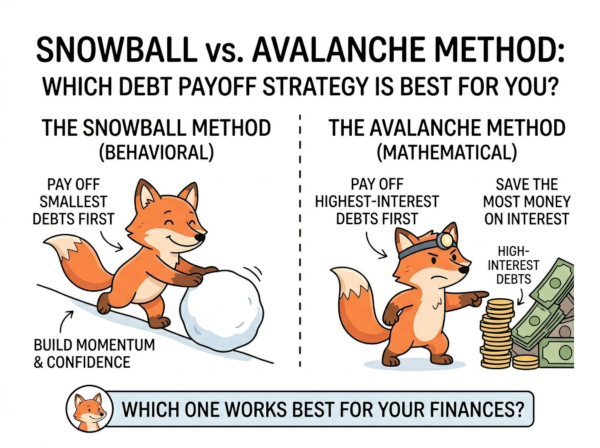
The Debt Snowball method prioritizes human psychology over cold, hard math. With this strategy, you list all your debts in order from the absolute smallest balance to the largest balance, completely ignoring the interest rates. You throw every extra dollar of your budget at the smallest debt until it is completely wiped out, while maintaining the bare minimum payments on everything else.
Once the smallest debt disappears, you take its entire past monthly payment—alongside any extra budgeting surplus—and roll it into the next smallest balance. As each account is closed, your monthly repayment power grows larger and builds momentum, exactly like a snowball rolling down a hill. The core benefit here is emotional reinforcement: crossing an entire account off your list early provides an immediate hit of dopamine, breaking through financial paralysis and giving you the psychological fuel to keep going.
Method 2: The Debt Avalanche (The Mathematical Accelerator)
The Debt Avalanche method is the mathematically optimal choice for pure financial efficiency. With this framework, you list all your debts in order from the absolute highest interest rate to the lowest interest rate, completely ignoring the total balance size. You direct all your surplus capital toward the account that is compounding interest the fastest, while paying minimums on the rest.
By systematically attacking the highest interest rate first, you minimize the amount of money that vaporizes into pure lender profit each month. Once that top mathematical predator is destroyed, you avalanche that combined payment down to the asset with the next highest rate. This strategy guarantees that you will pay the absolute least amount of total interest over your debt-free journey and shortens your absolute time to structural freedom—provided you have the iron discipline to survive the long periods between closing out accounts.
Head-to-Head Comparison: Snowball vs. Avalanche
Choosing your debt-destruction weapon requires an honest evaluation of whether you need immediate psychological validation or strict mathematical savings.
| Strategic Vector | The Debt Snowball | The Debt Avalanche |
|---|---|---|
| Core Focus | Account balance size (Smallest to Largest). | Interest rate percentage (Highest to Lowest). |
| Primary Driver | Behavioral Psychology: Quick emotional wins build long-term lifestyle habits. | Financial Efficiency: Minimizing mathematical friction and cash waste. |
| Total Financial Cost | Higher total interest paid over the life of the payoff timeline. | The absolute lowest possible interest cost achievable legally. |
| Best Suited For | Savers who get overwhelmed easily and need immediate momentum to stay motivated. | Analytical, disciplined individuals who prioritize math over emotional milestones. |
The 4-Step Blueprint to Launch Your Debt Repayment Framework
Regardless of which methodology matches your personality profile, you must execute your strategy using an airtight operational sequence:
- Step 1: Gather the Raw Account Metadata. Log into your portals and extract three variables for every open liability: the absolute current balance, the exact annual percentage rate (APR), and the mandatory minimum monthly payment.
- Step 2: Freeze All Active Debt Accumulation. You cannot empty a boat if water is still rushing through the hull. Delete your credit card profiles from online retail sites, leave your physical cards locked at home, and commit to operating strictly on a cash or debit-envelope framework while executing your payoff plan.
- Step 3: Organize Your Target Order. Arrange your accounts based on your chosen philosophy. Sort by smallest balance for the Snowball configuration, or sort by highest APR percentage for the Avalanche configuration.
- Step 4: Automate the Baseline Rules. Put every single non-target debt on an automated electronic ACH draft for its exact minimum payment. This ensures you never face a late fee or damage your credit score while directing your manual budgeting surplus toward your primary target.
"In the battle against consumer debt, the best strategy is the one you will actually stick with until the balance hits zero." — The Sovereignty Rule
The Debt-Elimination Execution Script
When configuring your automated banking tools to feed your debt repayment framework, treat your surplus cash as a precision projectile. Do not mix your variable spending money with your repayment capital. Establish an unyielding operational routine inside your financial accounts:
By taking control of your repayment strategy, you strip away the emotional shame often associated with consumer balances. You stop viewing debt as a permanent life sentence and start viewing it as a temporary math problem waiting to be solved. Pick your method, lock in your targets, and watch your financial freedom expand with every single closed account.