How to Fix Your Credit Score Quickly: Step-by-Step Blueprint
Your credit score is the single most critical financial gatekeeper in your adult life. It acts as a digital passport that institutions use to judge your reliability. A low score doesn't just block you from landing a mortgage or buying a car; it quietly forces you to pay thousands of dollars in inflated interest rates, premium insurance markups, and mandatory security deposits. Most people assume that once their credit takes a hit, they are locked out of the financial system for a decade. But what if you could rewrite your credit profile in a matter of weeks by executing a few highly targeted maneuvers?
Welcome to The Fast-Track Credit Correction Blueprint. In the modern banking ecosystem, credit scores are calculated by cold, automated algorithms pulling data from corporate repositories. These systems are highly reactive and, more importantly, prone to systemic tracking errors. By understanding the exact variables that feed these scoring models and deploying legal, strategic consumer interventions, you can force the algorithms to recalculate your risk and spike your score. Today, we will break down the exact step-by-step strategy to optimize your credit profile quickly.
The Anatomy of Your Score: Targeting the Highest Leverage Vectors
To fix your credit profile rapidly, you must stop guessing and target the exact mathematical weights that compile your score. The two heaviest corporate levers are your Payment History (35%) and your Amounts Owed / Credit Utilization Ratio (30%). Combined, these two categories dictate nearly two-thirds of your entire credit reputation.
If you focus your energy on minor variables like opening new accounts or changing your address, your score will remain stagnant. However, if you systematically eliminate errors from your payment history and deploy tactical liquidity movements to crush your active utilization ratio, you alter the core data blocks. This forces the scoring software to dynamically elevate your credit bracket during the very next monthly reporting cycle.
The 4-Step Action Plan to Rebuild Your Credit Profile
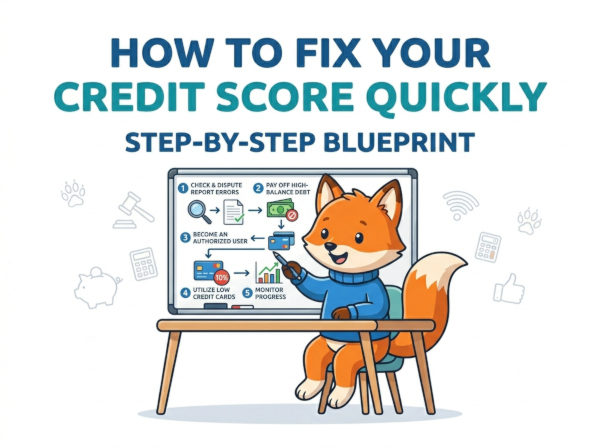
To successfully force a rapid upward recalculation of your credit score without hiring predatory credit repair sharks, execute this systematic operational sequence:
- Step 1: Pull Your Official Itemized Credit Reports for Free. Do not rely on simplified third-party credit monitoring apps that give you estimated scores. Log into the federally mandated portal (AnnualCreditReport.com) and download your official, comprehensive, multi-page data profiles from all three major bureaus: Experian, Equifax, and TransUnion.
- Step 2: Isolate and Dispute Reporting Inaccuracies Immediately. Scan every single line item on your reports. Look for late payments that you actually paid on time, incorrect balance amounts, or outdated collection accounts that are over seven years old. Launch a formal digital dispute with the respective bureau detailing the error; by law, if the original creditor fails to provide physical proof of the debt within 30 calendar days, the item must be permanently erased.
- Step 3: Execute the "Rapid Utilization Crush" Strategy. Your credit utilization ratio looks at how much debt you owe compared to your total limit across all revolving cards. If you carry a balance that exceeds 30% of your limit, your score drops. Pay down your balances so they sit below 10% of your limit. If you lack the cash to do this instantly, call your card issuer and request a credit limit increase; as long as your income is stable, a higher limit instantly shrinks your utilization percentage on paper, boosting your score within days.
- Step 4: Secure an "Authorized User" Piggyback Boost. Find a close family member or spouse who possesses an immaculate, long-standing credit history with a high-limit card that carries a zero balance. Ask them to add your name as an "Authorized User" on that specific account. You do not even need to receive the physical piece of plastic; the moment their bank reports the account data to the bureaus, their decades of perfect payment history copy-paste directly onto your personal report, instantly updating your score.
The Credit Factor Allocation Matrix
Understanding how the scoring software weights your financial behaviors allows you to allocate your cash reserves and administrative energy for the absolute maximum return on effort.
| Credit Score Component | Algorithmic Weight | The Underlying Systemic Trigger | The Fast Repair Protocol |
|---|---|---|---|
| Payment History | 35% Weight | Tracks whether you pay your bills on time or run into default flags. | Audit and dispute invalid late marks; set up automated minimum ACH drafts on all active accounts. |
| Credit Utilization | 30% Weight | The percentage of available revolving credit lines you are actively consuming. | Pay balances down beneath 10% or strategically request a credit limit expansion. |
| Length of Credit History | 15% Weight | The average age of your open financial accounts over time. | Keep your oldest legacy credit accounts open and active, even if you rarely use them. |
| Credit Mix & New Credit | 20% Weight | The diversity of your account types (loans vs. cards) and recent credit inquiries. | Freeze unnecessary new credit applications; minimize hard inquiries within a short window. |
The Official Credit Verification Challenge Script
If you uncover a negative, inaccurate, or unverified collection account on your credit report, you should never communicate with the bureau using emotional language. The automated optical character recognition (OCR) systems used by bureaus are trained to dismiss generic form letters. To cut through the automated defenses and force a strict federal investigation, use this exact factual compliance structure when launching your dispute:
By using precise statutory framing and providing specific account indices, you force a manual data compliance check. The bureaus realize you understand your legal protections, shifting the leverage back into your hands. As you systematically purge old errors and optimize your active balances, you break free from high-interest traps, unlocking the clean financial path required to claim your true long-term economic independence.