Financial Habits of the Minimalist Millionaire: Small Changes with Big Impact
When most people picture a millionaire, their minds instantly conjure images of luxury status symbols: high-end sports cars, massive estates, and designer wardrobes. We are conditioned by media engines to believe that wealth is defined by loud, visible consumption. But there is a silent class of quiet achievers who operate under a completely different paradigm. They accumulate immense wealth not by increasing the complexity of their lives, but by aggressively scaling their simplicity.
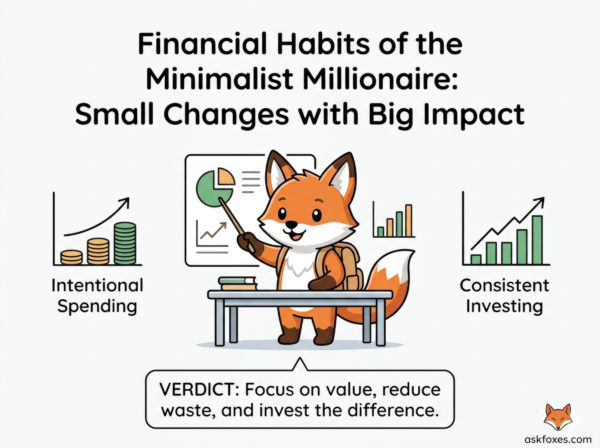
Welcome to The Minimalist Millionaire Blueprint. In behavioral economics, true financial freedom belongs to those who successfully decouple their personal fulfillment from material acquisition. The minimalist millionaire understands that every object you own demands three critical resources: your money, your physical space, and your mental energy. By optimizing for spatial and cognitive freedom, they unlock a massive financial arbitrage loop that turns unspent capital into compounding generational wealth. Today, we will deconstruct the small, intentional habit shifts that create a massive long-term balance sheet impact.
The Capital Arbitrage Engine: High Income meets Low Overhead
The math behind building an independent fortune is surprisingly straightforward, yet rarely executed efficiently. The average consumer allows their lifestyle overhead to rise in lockstep with their career advancement—a trap we identify as lifestyle creep. The minimalist millionaire, however, engineers a wide, permanent structural gap between their earning curve and their spending baseline. They view a salary increase or business windfall not as a license to buy more things, but as raw fuel to purchase more assets.
By keeping their fixed baseline costs intentionally low and stable, their savings rate scales exponentially with every promotion or side-hustle breakthrough. They aren't practicing deprivation; they are simply prioritizing the ultimate luxury asset: absolute time sovereignty.
The 4-Step Action Plan to Adopt Millionaire Minimalist Habits
To successfully integrate the foundational financial habits of the minimalist millionaire into your existing daily routine, execute this highly structured lifestyle framework:
- Step 1: Shift from Material Ownership to Access Architecture. Stop buying expensive tools, specialized gear, or seasonal luxury items that sit unused in your garage for 350 days a year. Embrace the modern sharing economy, local community co-ops, and public library networks to rent, borrow, or lease access to physical goods only when explicitly needed, wiping out hidden depreciating asset traps.
- Step 2: Automate a "One-In, Two-Out" Asset Rule. To completely freeze physical and financial clutter at the source, commit to an uncompromising physical boundary. If you buy a new piece of clothing, an electronic gadget, or a household item, you must sell, donate, or recycle two existing items within your household. This creates immediate psychological friction before any retail purchase, instantly blocking impulse spending.
- Step 3: Establish a Quality-Centric "Cost-Per-Use" Buying Filter. When you absolutely must purchase a physical asset, abandon the trap of buying the cheapest available item, which inevitably breaks and requires frequent replacement. Buy the highest quality, most durable tool available, and divide its retail price tag by its projected lifetime uses. True minimalists buy things once and maintain them meticulously.
- Step 4: Cultivate an Inverted Status Perspective. Re-engineer your internal reward mechanisms. Instead of seeking validation from external peers through highly visible material markers, derive deep personal satisfaction from invisible, secure balance sheet milestones. Make your net worth statement, your liquid emergency buffer, and your compounding dividend stream your true source of status and peace.
The Consumption Spectrum: The Standard Consumer vs. The Minimalist Millionaire
Analyzing the distinct behavioral patterns of these two financial archetypes reveals how minor daily deviations compound into entirely different life outcomes.
| Behavioral Vector | The Standard Consumer Model | The Minimalist Millionaire Model |
|---|---|---|
| Asset Acquisition Filter | Driven by external novelty, societal trends, and sudden impulse waves. | Driven strictly by long-term structural utility, durability, and mental clarity. |
| Subscription Handling | Accumulates dozens of background convenience leaks without active auditing. | Maintains a lean, highly curated digital footprint; cancels underutilized services instantly. |
| Space & Storage | Pays premium rental fees for external storage units to house accumulating clutter. | Optimizes physical square footage; views open, clean spatial layouts as a primary luxury. |
| Financial Destiny | Perpetual Golden Handcuffs: Forced to work indefinitely to feed a high-overhead lifestyle. | Absolute Autonomy: Capable of walking away from any unfulfilling corporate loop at a moment's notice. |
The "Essentialist Capital" Allocation Protocol
When clearing out your financial and physical clutter, you must script your account rules to lock in your newly reclaimed capital automatically. Do not let your savings sit idly in your transactional checking account, where it risks being absorbed by accidental micro-spending leaks. Configure your banking infrastructure to act like an intentional filter system:
By shifting your daily focus away from what you can buy and toward what you can achieve, you bypass the exhausting, endless cycle of consumer competition. You stop feeling the pressure to project wealth to the world because you possess the quiet confidence of actual financial independence. True wealth isn't about owning a massive collection of material things—it is about possessing the absolute freedom to do exactly what you want with your time, every single day.