The 80/20 Rule at Work: How to Do Less Work and Still Get Promoted
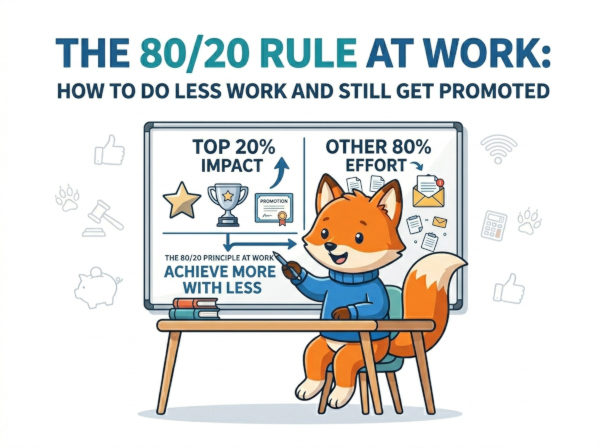
In the modern corporate workplace, the volume of tasks assigned to you is virtually infinite, but your daily capacity is strictly finite. Most professionals attempt to clear their entire to-do list, believing that total completion equals professional success. This is a trap. In reality, the vast majority of tasks assigned to you contribute minimally to your career trajectory. To break through the "busywork" ceiling and secure a promotion, you must master the 80/20 rule—also known as the Pareto Principle—to systematically strip away the noise and focus exclusively on the 20% of work that drives 80% of your performance metrics.
Welcome to The High-Leverage Career Manifesto. Elite operators do not get promoted because they are the busiest people in the office; they get promoted because they are the most impactful. By identifying and aggressively prioritizing the specific outputs that leadership actually values, you can reduce your total workload volume while simultaneously increasing your professional profile and visibility. Today, we will deconstruct the Pareto Principle for the corporate environment and show you how to engineer your workflow for maximum promotion impact with minimum operational effort.
The Impact Audit: Distinguishing Busywork from Career-Value
To apply the 80/20 rule, you must first develop the discipline to audit your daily activity log with clinical detachment. Every morning, categorize your upcoming tasks into two buckets: "Mechanical Maintenance" and "High-Leverage Output." Mechanical tasks are the emails, status pings, and administrative data entry that keep the machine running but go unnoticed by leadership. High-leverage outputs are the specific projects that solve executive pain points, drive revenue, or enhance the team's structural efficiency.
Your goal is not to perform more work; it is to prioritize the 20% of your tasks that leadership uses to evaluate your performance. When you focus your energy here, you deliver better results in less time, creating the perception that you are a highly efficient, high-value asset who manages their time with strategic maturity.
The 4-Step Blueprint to Engineering Your Promotion
- Step 1: Identify Your "KPI-Direct" Tasks. Review your specific promotion criteria or your manager’s stated priorities. Map every single one of your recurring weekly tasks directly to a specific KPI. If a task does not map to a key performance indicator, it is a candidate for automation, delegation, or elimination.
- Step 2: Implement "Deep Work" Blocks. Reserve your peak cognitive hours—typically the first 90 minutes of your morning—exclusively for your 20% high-leverage work. Prohibit yourself from opening email, chat apps, or status trackers during these sessions to ensure your highest-value output is protected from administrative erosion.
- Step 3: Communicate Your Impact, Not Your Volume. Stop reporting on how "busy" you are. Instead, frame every status update around the 20% of your work that actually matters. When you update leadership, highlight the revenue impact or efficiency gains you've achieved, effectively training them to view you as a strategic partner rather than a task-completer.
- Step 4: Automate the Maintenance 80%. For the remaining 80% of your work that is still required but provides low career leverage, deploy the automation micro-skills you've already mastered. Use text-expanders, scheduled status reports, and AI templates to fulfill these responsibilities in seconds, freeing your calendar for additional high-leverage growth tasks.
The Career Leverage Matrix: Low-Value vs. High-Impact
Identifying where you spend your time is the first step toward reclaiming your career trajectory. Use this matrix to evaluate the tasks currently crowding your schedule.
| Activity Type | The 80% (Noise) | The 20% (Leverage) |
|---|---|---|
| Communication | Replying to every email/chat ping in real-time. | Sending structured, impactful reports that solve executive issues. |
| Project Execution | Focusing on perfecting minor, non-critical details. | Focusing on delivering core functionality that drives team targets. |
| Professional Focus | "Staying busy" to look active to your management team. | Delivering clear, measurable results that move the KPI needle. |
| Career Outcome | Perpetual Employee: You remain a replaceable unit doing "the job." | Promotion Candidate: You are seen as an essential, high-impact operator. |
The 80/20 Promotion Configuration Script
When restructuring your workday, do not ask for "more time." Instead, build the operational systems that force your work to compress. Use this precise system logic to automate your administrative load and focus your human capital on the 20% of work that guarantees your upward trajectory:
By moving from a model of "doing it all" to "doing what matters most," you stop the cycle of professional burnout and start the cycle of professional acceleration. You demonstrate to leadership that you understand how to prioritize effectively, manage your own time, and deliver outsized results compared to your peers. True career growth in the modern era is not about the number of hours you put in; it is about the calculated, high-impact results you deliver by focusing solely on the 20% that dictates your future success.