Workplace Navigators: How to Handle a Toxic Manager Like a Professional
There is no greater friction point in a professional career than a direct supervisor who operates from a place of insecurity, inconsistency, or outright hostility. Dealing with a toxic manager can make your daily work life feel like a constant, draining survival game. However, the worst mistake you can make is responding to toxicity with emotion. When you mirror their volatility, you forfeit your professional standing and give them the very leverage they need to characterize you as the problem. To win, you must operate on a higher, more surgical level.
Welcome to The Professional Neutralization Protocol. Navigating a dysfunctional management layer isn't about winning a confrontation; it is about building an impregnable defense around your reputation and output. By shifting your approach from reactive to clinical, you insulate your career from the instability of your supervisor. Today, we will deconstruct the behavioral framework to successfully neutralize a toxic manager and secure your long-term professional runway.
The Strategy of Clinical Professionalism
Toxic management thrives on ambiguity, fear, and impulsive communication. They rely on "gotcha" moments, inconsistent expectations, and verbal instructions that leave no trail. Your defense is simple: you must convert every interaction into objective data. When a manager knows that every request, critique, and goal shift is being logged, verified, and confirmed, their ability to create chaos is fundamentally broken.
Your goal is to become the "un-rattleable" employee. Regardless of how volatile, unfair, or scattered their behavior becomes, you respond with consistent, calm, and highly organized professionalism. You are not just doing your job; you are managing your manager by providing them with the exact structure, clarity, and documentation they lack, effectively forcing them to act professionally simply by refusing to engage in any other way.
The 4-Step Blueprint to Neutralize Toxic Dynamics
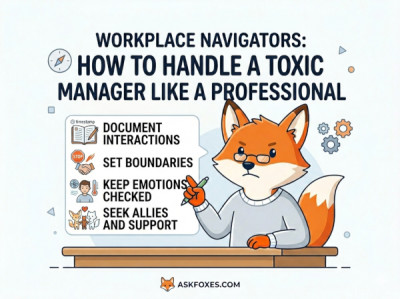
To protect your sanity and career trajectory while working under a difficult leader, execute this systematic operational framework:
- Step 1: Shift All Communication to Asynchronous Tracks. If a manager tries to deliver critical instructions or critique you in a verbal-only environment, move the loop to email or a project management system immediately. Respond with: "To ensure I align perfectly with your priorities, could you please summarize those points in an email or ticket? I want to make sure I don't miss a single detail."
- Step 2: Implement the "Documented Confirmation" Loop. After every 1-on-1 meeting or informal verbal request, send a brief, polite "recap" email to the manager: "Just confirming my understanding of our conversation: 1) [Task], 2) [Deadline], 3) [Expected Outcome]. Please let me know if I missed anything." This creates a permanent, undeniable evidence trail that prevents future gaslighting or shifting deadlines.
- Step 3: Establish Strict Boundaries on Emotional Engagement. Never vent, complain, or share personal frustration with your manager, regardless of how much they invite you to do so. Maintain a "neutral-positive" persona. Keep your workplace interactions strictly focused on the task at hand, operational goals, and team deliverables. When you remove the emotional hook, you remove their power.
- Step 4: Build a Parallel Executive Network. Don't let your immediate manager be your only view into the organization. Systematically build relationships with other leaders, mentors, and cross-functional partners in the company. A strong internal reputation that extends beyond your direct reporting line acts as a critical safety net if your manager's behavior ever escalates to professional sabotage.
The Response Matrix: Emotional Reaction vs. Professional Neutralization
Comparing these two behavioral paths demonstrates how quickly you can flip the power dynamic by refusing to participate in the toxicity loop.
| Operational Metric | The Reactive Emotional Trap | The Professional Neutralization Model |
|---|---|---|
| Verbal Feedback | Defensive, immediate, or emotional; mirrors the manager's volatility. | Calm, data-driven, and focused on task-based alignment. |
| Task Communication | Reliance on verbal chats that vanish once the meeting ends. | Aggressive use of written confirmation emails for every instruction. |
| Office Presence | Venting to peers or coworkers to cope with the daily stress. | Maintaining a high-value output profile while building relationships elsewhere. |
| Corporate Perception | Internal Volatility: You are seen as "difficult" or "instable" by leadership. | High-Value Operator: You are seen as the calm, professional anchor in a chaotic team. |
The "Structured Alignment" Communication Script
When a toxic manager attempts to create confusion by shifting priorities or assigning blame, your best weapon is calm, structured over-clarification. Do not argue. Simply present the facts of the workflow and ask for prioritization. Use this script to force their hand and move the interaction back to a professional baseline:
By using this approach, you effectively strip the toxicity out of the interaction. You don't fight the manager; you fight the lack of clarity. You position yourself as the ultimate professional—a stable, predictable, and highly efficient operator who continues to deliver value regardless of the environment. You maintain your peace of mind, safeguard your professional reputation, and keep your options open to exit to a better environment on your own timeline, completely on your own terms.