Say No Safely: How to Decline Social Plans Without Feeling Guilty
Most of us say "yes" to social invitations out of a fear of missing out, a desire to please, or simple hesitation. The result is a calendar bloated with commitments that drain your cognitive reserves and divert you from your primary goals. To reach elite levels of productivity, you must stop viewing your time as a communal resource and start treating it as your most finite, non-renewable asset.
Welcome to The Tactical Refusal Protocol. Declining social invitations is not an act of hostility; it is an act of priority management. When you say "no" to a low-value event, you are saying "yes" to your own deep-work objectives. Today, we will deconstruct the psychological script required to decline plans firmly, politely, and without the crippling guilt of social obligation.
The Anatomy of a High-Impact "No"
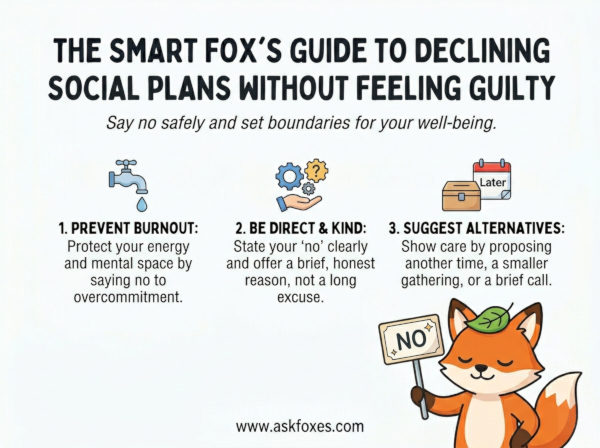
The biggest mistake people make is over-explaining. When you provide a laundry list of excuses, you give the other person "hooks" to negotiate with. A high-value refusal is brief, kind, and final.
The 4-Step Blueprint to Strategic Refusal
- Step 1: The "Immediate Buffer." Do not feel pressured to respond instantly. If you are uncertain, use the "I’ll check my calendar and get back to you" line. This gives you the breathing room to evaluate the event’s actual ROI against your current priorities.
- Step 2: The "Kind & Clear" Pivot. Express appreciation for the invite—this maintains your social capital—then pivot immediately to your inability to attend. Avoid "I'm sorry" unless you have genuinely let them down; use "Thank you for the invite" instead.
- Step 3: The "Closed-Loop" Reason. You do not owe anyone a detailed itinerary of your life. A simple "I have a prior commitment" or "I’m in a heavy focus period for my current project" is a sufficient, unassailable reason.
- Step 4: The "Future-Value" Bridge. If you actually value the person, suggest a concrete, low-friction time in the future to reconnect on *your* terms (e.g., "I'm tied up this weekend, but I’d love to catch up over coffee next month"). This proves the refusal is about time management, not about the person.
The Refusal Matrix: Social Obligation vs. Sovereign Focus
Assess your invitations using this matrix to determine when to say "yes" and when to protect your time.
| Invitation Type | Value Level | Strategic Protocol |
|---|---|---|
| Core Network | High | Prioritize; attend to maintain high-value relationships. |
| Vague Acquaintance | Low | Decline using the "Future-Value" bridge. |
| Generic/Large Events | Very Low | Polite, immediate, and concise refusal. |
| Direct Conflict | N/A | Sovereign Choice: Protect deep-work blocks at all costs. |
The "Strategic Refusal" Operational Code
When you feel the internal pressure to say "yes" to something you don't want to do, use this logic to override your social programming and hold your ground:
By mastering the art of the "no," you cease being a reactive participant in others' schedules and become the architect of your own. You will find that people respect your boundaries more when you enforce them consistently. Protect your time as you would your most precious resource, and use that reclaimed space to execute the goals that actually matter.