How to Use AI Tools to Write Your Resume and Bypass ATS Screeners
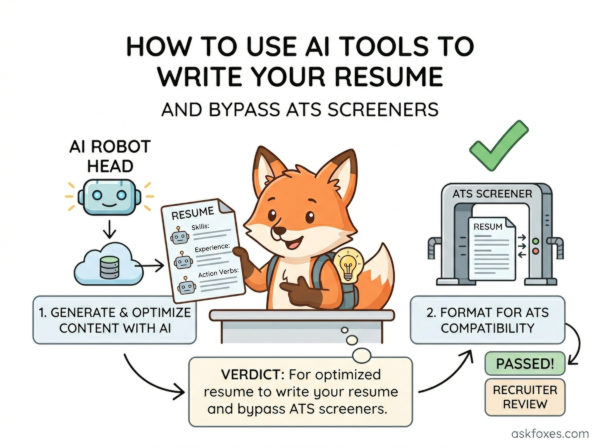
In 2026, the battle for a job interview starts with an algorithm. Applicant Tracking Systems (ATS) act as the first gatekeeper, parsing your resume to determine if your experience aligns with the job requirements. If your document is formatted incorrectly or misses key contextual signals, your application may never reach a human recruiter. However, you do not need to "game" the system with hidden keywords or deceptive tricks. You need to engineer a document that is mathematically optimized for machine parsing and semantically aligned with the role.
Welcome to The ATS Optimization Blueprint. High-level career success in the digital era requires you to treat your resume as a technical asset. By aligning your document structure with machine-readable standards and using AI tools for precision keyword mapping, you ensure that your professional narrative is captured, indexed, and ranked at the top of the recruiter's screen. Today, we will deconstruct the exact mechanical configuration required to bypass ATS screeners effectively.
The Mechanical Architecture: Optimizing for Machine Parsing
Modern ATS software uses Optical Character Recognition (OCR) and text extraction to "read" your file. If your resume uses complex visual design elements, the machine will likely scramble the data, resulting in a rejected application. To ensure your file is perfectly readable, you must prioritize mechanical clarity over visual flair.
The 4-Step Mechanical Optimization Protocol
- Step 1: Standardize Your Document Structure. Use a single-column layout with standard, clear section headers (e.g., "Experience," "Education," "Skills"). Avoid sidebars, tables, or multi-column designs that confuse text extraction algorithms.
- Step 2: Eliminate Formatting Traps. Remove all text boxes, icons, images, charts, and graphics from your resume template. ATS platforms often skip or fail to extract data located within these visual layers, causing critical information to be lost during the parsing process.
- Step 3: Choose the Correct File Wrapper. Stick to a standard .docx file for the highest parsing accuracy, or use a simple, text-based PDF. Avoid scanned PDFs, as these are image-based and often unreadable by automated systems.
- Step 4: Perform the "Notepad Test." Copy all your resume text and paste it into a plain-text editor like Notepad. If the resulting text appears jumbled, scrambled, or out of order, the ATS will receive that same disorganized data.
The Semantic Strategy: Keyword Mapping with AI
Because modern systems use semantic matching, stuffing your resume with isolated keywords is no longer effective. Instead, you must mirror the language of the job description in a natural, contextual way.
| AI Strategy Component | The Outdated Approach | The 2026 Semantic Model |
|---|---|---|
| Keyword Usage | Filling the page with repetitive, dense lists of buzzwords. | Integrating exact job description terminology naturally within achievement bullets. |
| Achievement Focus | Listing standard duties and responsibilities. | Using AI to translate duties into quantified, results-oriented impact statements. |
| AI Utility | Generating the entire resume from scratch. | Using AI as an editor for gap analysis and keyword contextualization. |
The AI-Assisted Resume Drafting Workflow
Use artificial intelligence to audit your experience, not to fabricate it. Treat AI as a precision editor that identifies weaknesses in your professional narrative.
- Gap Analysis: Feed your resume and the specific job description into an AI-powered resume checker to identify missing critical skills or section-specific weaknesses.
- Impact Transformation: Input your raw result data into an AI tool and request variations that emphasize measurable outcomes (e.g., "Led a 10-person team to reduce churn by 15%").
- Final Verification: Ensure that no critical information is placed in headers or footers, as many ATS platforms ignore these areas entirely. Always conduct a human-readability check to ensure the content remains professional, clear, and focused on value rather than just matching algorithm scores.
By shifting your focus toward mechanical parsing efficiency and semantic relevance, you remove the "luck" element from your job search. You ensure your hard-earned experience isn't hidden behind a technical parsing error, but is clearly presented, indexed, and ranked by the systems that control your career trajectory. Master these optimization layers, and you move from being another anonymous entry in the database to a top-tier candidate in the recruiter's queue.