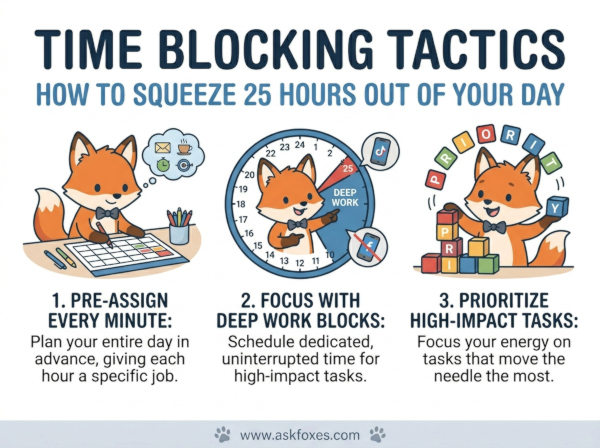
Time Blocking Tactics: How to Squeeze 25 Hours Out of Your Day
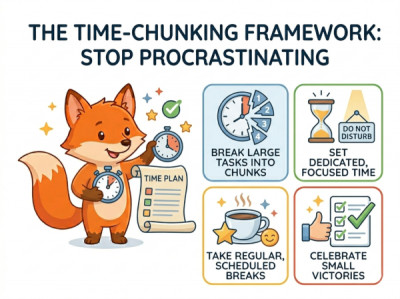
The standard 24-hour day is a rigid constraint that most people accept as unchangeable. However, high-performers view time as a flexible asset that can be compressed and optimized. The reality is that you aren't "out of time"—you are losing your time to the friction of context switching, the tyranny of reactive communication, and the lack of a structured, deep-work environment. To reclaim those lost hours, you must move beyond simple to-do lists and adopt the architectural discipline of time blocking.
Welcome to The Temporal Optimization Framework. Time blocking is not just about scheduling tasks; it is about protecting your cognitive sovereignty. By compartmentalizing your day into rigid, high-focus zones, you can eliminate the "switching cost" that kills your productivity and force your brain into a state of high-leverage flow. Today, we will deconstruct the exact tactical setup required to squeeze an extra "bonus hour" out of your daily schedule.
The Anatomy of an Optimized Day
Most people treat their calendar as a repository for meetings. You must treat your calendar as a strategic tool for directing your life force. If a block of time is not assigned to a specific task, it is effectively dead time that will be consumed by low-value noise and interruptions.
The 4-Step Blueprint to Tactical Time Blocking
- Step 1: The "Theme-Based" Daily Layout. Stop assigning random tasks to random hours. Group similar activities into "Theme Blocks" (e.g., all administrative tasks in one 90-minute block, all creative/deep-work in a 3-hour morning block). This minimizes the mental load required to change gears.
- Step 2: Initialize "Deep Work" Fortress Blocks. Protect your highest-ROI tasks by placing them in your absolute peak-energy hours. During these blocks, implement "Zero-Access" protocols: close your email, turn off all notifications, and put your phone in another room.
- Step 3: Account for the "Transition Buffer." Do not pack blocks back-to-back. Build in 10-minute "Reset Blocks" between major tasks to allow your brain to recalibrate, hydrate, and prepare for the next objective.
- Step 4: The Daily Sunset Review. Never end your day without blocking out the next day. By pre-scheduling every hour of your tomorrow, you eliminate the "morning paralysis" of deciding what to work on, allowing you to hit your first block with immediate intensity.
The Productivity Matrix: Reactive vs. Optimized Workflow
Compare the impact of a chaotic, reactive schedule against a block-optimized strategy to see where your hidden hours are currently leaking.
| Operational Metric | The Reactive To-Do List | The Time-Block Protocol |
|---|---|---|
| Attention Span | Fragmented; interrupted by every incoming notification. | Sustained; focused entirely on a single high-leverage objective. |
| Daily Output | Volume-based; clearing as many "easy" items as possible. | Value-based; achieving the critical tasks that drive progress. |
| Mental Energy | Drained by midday due to constant context switching. | Preserved through structured focus and intentional rest. |
| Time Utilization | Efficiency Leak: Hours lost to distractions and "busywork." | Asynchronous Mastery: Maximized output with time left over. |
The "Temporal Compression" Operational Code
When you start time blocking, you will realize that you have far more capacity than you previously believed. Use this internal logic to maintain your focus and prevent "block-creep," where administrative tasks expand to fill your entire calendar:
By engineering your day through rigorous time blocking, you stop being a servant to your notifications and become the architect of your own schedule. You create the space necessary to execute at a higher level than your peers, delivering consistent, high-impact results while maintaining the personal autonomy to own your time. Master the block, and you effectively manufacture the extra time required to scale your life and your career.