The 2-Minute Rule: The Easiest Hack to Beat Procrastination Instantly
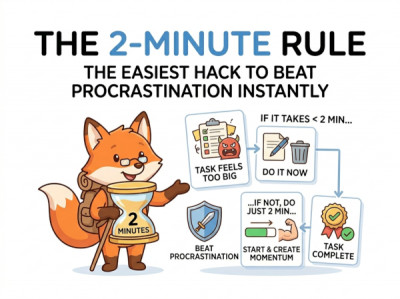
We often think procrastination is a time-management problem, but it is actually an emotional-regulation problem. We delay starting tasks because they feel heavy, complex, or tedious, and our brains naturally seek the path of least resistance. The 2-Minute Rule is the psychological circuit breaker that forces your brain to bypass that initial hesitation and start moving.
Welcome to The 2-Minute Activation Protocol. The magic of this rule lies in its simplicity: if a task takes less than two minutes to complete, you do it immediately. By lowering the barrier to entry, you stop treating your work as a mountain to climb and start treating it as a series of small, manageable physical actions. Today, we will deconstruct how to use this rule to turn your "to-do" anxiety into momentum.
The Activation Framework: Breaking the Procrastination Loop
Procrastination thrives on the "big project" narrative. When you tell yourself you need to "write a report," your brain sees a massive, undefined task. When you tell yourself you just need to "open the document and type the first sentence" (a 2-minute action), you have already started, which is 90% of the battle.
The 4-Step Blueprint to Instant Momentum
- Step 1: The "Immediate Audit." As soon as a task enters your awareness—an email, a bill, a quick file update—ask: "Does this take less than two minutes?" If the answer is yes, do it right now.
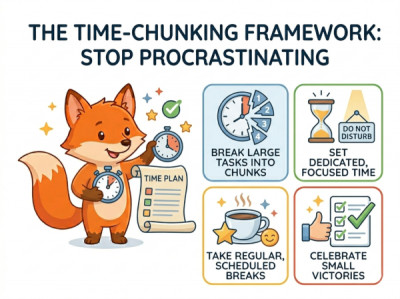
- Step 2: The "Gateway Initiation." For larger projects, use the 2-Minute Rule to get started rather than to finish. Tell yourself you will work on the project for only two minutes. Once you have initiated the action, the "sunk cost" of your effort usually drives you to continue.
- Step 3: Eliminate the "Mental Backlog." Tasks that take less than two minutes are not worth scheduling or writing on a list. Storing them in your brain creates cognitive clutter; doing them immediately frees your mental RAM for higher-level work.
- Step 4: Standardize Your Response. The 2-Minute Rule works best when it becomes a default habit. When a request hits your desk, treat the 2-minute check as your first operational filter before you even categorize the item.
The Procrastination Matrix: Hesitation vs. Activation
Compare the impact of the "procrastination loop" against the "2-Minute Activation" to understand how your task-management strategy defines your productivity.
| Operational Metric | The Procrastination Loop | The 2-Minute Activation |
|---|---|---|
| Initial Friction | High; constant cycle of re-assessing and avoiding. | Near-zero; the action is executed before you can think about it. |
| Mental Load | High; "clutter" accumulates as tasks pile up. | Minimal; the task is finished and removed from memory. |
| Output Velocity | Low; energy spent avoiding work, not doing it. | High; rapid completion of small tasks builds momentum. |
| Career Perception | Reactive: You are seen as disorganized or "behind." | Efficient: You are seen as an operator who clears the path. |
The "Immediate Execution" Operational Code
When you feel that specific "pull" of resistance to starting a task, use this internal logic to bypass your brain's avoidance mechanism and kick-start your productivity:
By automating your response to small tasks, you stop procrastinating because you stop giving your brain the *time* to procrastinate. The 2-Minute Rule is not about being faster at work; it is about being smarter with your attention. Master this simple shift, and you will find that the "overwhelming" pile of work you thought you had simply evaporates through consistent, small-scale action.