Best Free Travel Apps Every Budget Traveler Needs on Their Phone
In a world where logistics and pricing change by the millisecond, your smartphone is not merely a communication device—it is your operational command center. Relying on disorganized browser tabs or disconnected email confirmations is a massive inefficiency that leads to missed opportunities and increased costs. To travel like a high-output operator, you must curate a lean, effective stack of free applications that act as force multipliers for your budget and sanity.
Welcome to The Mobile Travel Command Protocol. This is not about cluttering your phone with novelty apps; it is about deploying purpose-built tools that solve specific, high-frequency travel challenges. Today, we will deconstruct the essential utility-stack required to manage your travel infrastructure with professional precision.
The Essential Utility-Stack
Organize your travel applications into three distinct operational domains: Logistics, Intelligence, and Operational Security.
The 4-Category Utility Blueprint
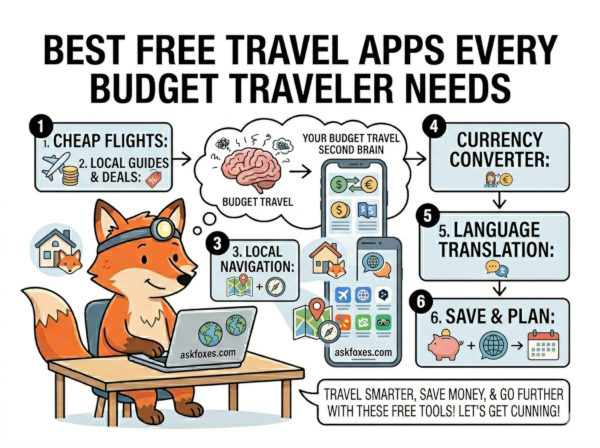
- Domain 1: Logistics & Itinerary Management (TripIt / Google Maps). Use TripIt to automatically consolidate your flight, hotel, and rental car confirmations into a single, real-time master timeline. Supplement this with Google Maps for offline navigation and identifying public transit routes, which significantly reduces the need for expensive taxi or ride-share services.
- Domain 2: Price Intelligence & Fare Mining (Google Flights / Skiplagged / Going). Deploy Google Flights as your primary engine for tracking price fluctuations and exploring "multi-city" routes to exploit lower fare classes. Use Skiplagged specifically to identify "hidden city" ticketing opportunities that allow you to bypass standard, inflated pricing. Integrate alerts from services like Going or Secret Flying to monitor for "error fares"—glitch-priced tickets that offer 80–90% discounts.
- Domain 3: Knowledge Management (Notion / Google Keep). Treat your note-taking app as your "Second Brain" for travel. Use it to capture insights, store destination research, and organize your PARA-structured project notes to ensure you have actionable information ready when you arrive.
- Domain 4: Operational Security (Bitwarden). Secure your digital life by using a free, open-source password manager like Bitwarden. This ensures your travel-related logins and sensitive account credentials are protected as you traverse different, potentially insecure network environments.
The Operational Matrix: Passive vs. Tactical Toolset
Compare the impact of standard travel habits against the tactical, tool-driven protocol to see how your travel efficiency is being optimized.
| Metric | Passive Travel Habits | Tactical Mobile Protocol |
|---|---|---|
| Itinerary Management | Scattered; reliant on paper or fragmented emails. | Centralized; real-time digital master timeline. |
| Cost Acquisition | Standard; paying market-rate prices. | Optimized; mining for error fares and hidden cities. |
| Navigation | Dependent on local drivers/taxis. | Self-sufficient via offline mapping tools. |
| Operational Load | Draining: High manual overhead. | Optimized: Automated and streamlined. |
The "Mobile Command" Operational Code
To keep your travel setup effective, treat your phone as an extension of your operational system. Execute this logic before every departure to maintain your high-performance baseline:
By shifting your travel mindset to prioritize utility and automation, you stop reacting to obstacles and start engineering your experience. You are not just visiting a destination; you are managing a project. Master these free, essential tools, maintain your digital hygiene, and you will find that traveling on a budget becomes a refined, repeatable, and highly efficient part of your professional lifestyle.