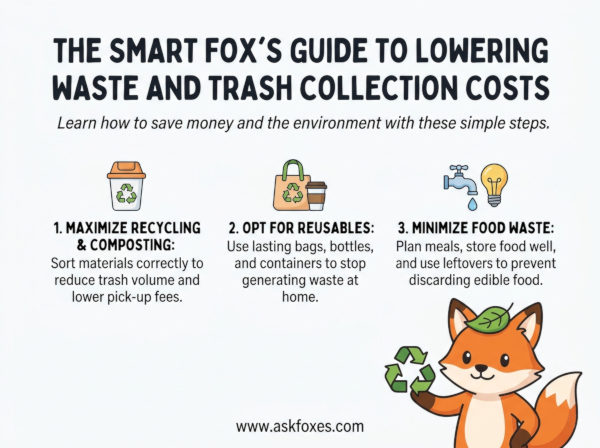
The Smart Fox’s Guide to Lowering Waste and Trash Collection Costs
It is a utility bill that almost everyone pays, yet almost no one questions. Every quarter, your local waste management company or municipality sends an invoice for trash collection, and you dutifully pay it. Most homeowners and renters assume waste removal is a fixed, regulated cost dictated by local geography. But what if you are paying for a massive 96-gallon bin when you only generate enough trash to fill a small bucket? Or what if your hauler is quietly padding your bill with fuel surcharges and environmental fees that can be legally negotiated away?
Welcome to The Smart Waste & Trash Cost Guide. In the realm of fixed household utilities, waste removal is one of the most overlooked targets for budget optimization. Hauling companies count on the fact that once a bin is dropped off at your curb, you will never review your service tiers or look into municipal alternatives. Today, we will show you exactly how to audit your trash production, break down predatory hauler invoices, and deploy tactics to shrink both your ecological footprint and your monthly bill.
The Economics of Waste: How Haulers Inflate Your Bill
Private waste collection companies operate on tight logistical margins, which means they constantly look for ways to extract extra revenue from their existing customer base. They do this primarily through two methods: volume inflation and arbitrary ancillary surcharges. If you moved into your home and simply accepted whatever default bin sizes the previous occupant used, you are likely overpaying for empty plastic space that sits on your curb every week.
Furthermore, look closely at the itemized breakdown on your statement. You will frequently find vague line items labeled "Administrative Fee," "Fuel Surcharge," or "Environmental Compliance Fee." These are rarely government-mandated taxes; instead, they are internal corporate operational costs that haulers pass onto unobservant consumers to boost their corporate profit margins.
The 4-Step Action Plan to Slash Trash Collection Fees
To successfully optimize your waste management expenses and stop throwing money into the garbage, execute this systematic strategic framework:
- Step 1: Conduct a 2-Week Waste Volume Audit. Before your next trash day, look inside your main bin. Is it consistently less than half full when the truck arrives? If so, you are paying for premium capacity that you do not use. Document your actual volume usage over a two-week period.
- Step 2: Request a Smaller Container Tier. Call your provider and explicitly demand to downsize your trash cart. Most haulers offer three distinct tiers: 32-gallon, 64-gallon, and 96-gallon. Moving down just one tier can slice your baseline collection bill by 20% to 40% immediately.
- Step 3: Eliminate Duplicate Recycling and Yard Waste Fees. Many private haulers charge separate monthly subscriptions for recycling and organic yard waste bins. Check if your municipality or a local community co-op offers free public drop-off sites for leaves, cardboard, and glass. If they do, cancel the extra bins and drop off items for free.
- Step 4: Audit Your Invoice for Ancillary Fee Removal. Call the billing department to challenge any non-governmental surcharges, using the targeted negotiation scripts detailed below.
Waste Infrastructure: Private Haulers vs. Municipal Tiers
Depending on where your home is located, your waste disposal framework will fall into one of two competitive categories. Knowing which structure you are in dictates your financial leverage.
| Collection Structure | Market Dynamics | Best Cost-Cutting Leverage |
|---|---|---|
| Open Market (Private Haulers) | Highly competitive; multiple private companies service the exact same streets. | High negotiation leverage. Threaten to switch to a direct competitor to wave hidden fees. |
| Exclusive Franchise / Municipal | A single company or city department has a legal monopoly over your zone. | Zero negotiation on rates. Your only leverage is container downsizing or moving to a "Pay-As-You-Throw" tag system. |
| Rural Subscription | No active curb service exists; residents must arrange their own disposal. | Form a neighborhood collection pool or utilize local landfill punch-cards instead of monthly contracts. |
The Billing Dispute and Competitor Price-Match Script
If you live in an open market zone serviced by private waste corporations, you should never pay full retail price. If your bill has steadily increased due to hidden surcharges, contact your provider's retention department and utilize this exact verbal script:
If you are dealing with a local monopoly where you cannot switch providers, switch your approach to target structural programs. Use this script to query local alternative fee structures legally mandated by environmental boards:
By shifting the conversation toward environmental metrics and volume compliance, you force the utility clerk to look up specialized administrative tiers. In many regions, these eco-conscious programs are legally required to exist but are never actively marketed to the public, offering a hidden shortcut to massive annual savings.